> ## Documentation Index
> Fetch the complete documentation index at: https://getlago.com/docs/llms.txt
> Use this file to discover all available pages before exploring further.
# Group keys
> Group usage by event properties: either to price each group separately, or to break it down on invoices and usage for visibility only.
A charge can group usage by the properties carried on your events. Lago offers two kinds of group keys, answering two different questions:
* **Pricing group keys** answer *"how much should each group cost?"* Each group becomes its own fee with its own price.
* **Presentation group keys** answer *"how is this fee broken down?"* The fee stays whole and priced once; Lago just shows how its units split across the groups, for visibility only.
You can use either on its own, or combine them on the same charge.
| | Pricing group keys | Presentation group keys |
| ---------------------------- | -------------------------- | --------------------------------------- |
| Affects pricing and amounts | Yes | No |
| Per-group breakdown shown as | Separate fees (line items) | Units-only sub-breakdown inside one fee |
| Keys per charge | Multiple | Up to 2 |
| Aggregation types | All | All |
## Pricing group keys
AI and infrastructure platforms often tailor pricing by geography, hosting provider, model type, or service tier. Pricing group keys let you reflect those real-world cost variations on a single charge, instead of duplicating products. Each group is metered and **priced independently**, and appears as its own fee on the invoice.
You don't predefine the values. Define the key on the charge, send events that carry it, and Lago routes each event to the right pricing group at runtime. Pricing group keys work with every charge model, and you can set more than one per charge.
On the charge, add a key in the **Pricing group key** field (e.g. `region`, `cloud`, `instance_type`), then send events that include that property.
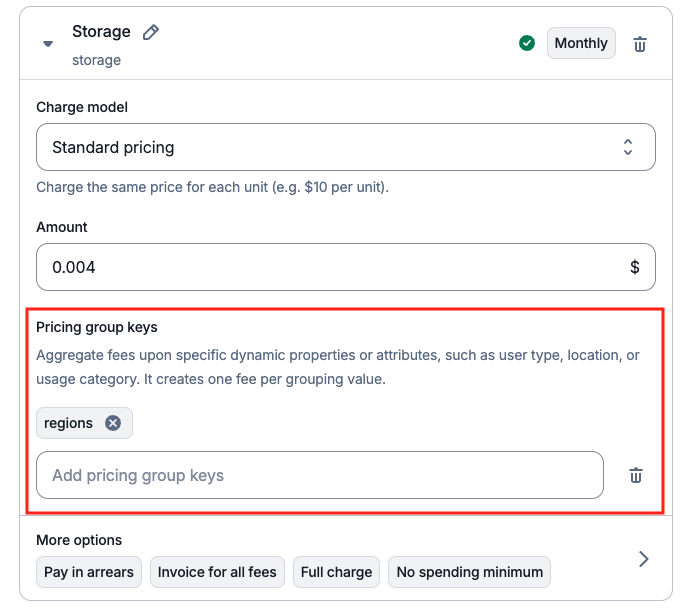 Pricing group keys live inside the charge `properties`:
```json theme={"dark"}
"properties": {
"amount": "1",
"pricing_group_keys": ["region"]
}
```
Events then carry the key like any other property:
```json theme={"dark"}
{ "event": { "code": "storage", "properties": { "gb": 20, "region": "us-east-1" } } }
```
**Example.** A Storage charge priced at `$1` per GB (`sum` of `gb`) with `pricing_group_keys: ["region"]`, receiving 10 GB in EU and 15 GB in US, produces **two separate fees**, each with its own units *and* amount:
```text theme={"dark"}
Storage
region = EU 10 units $10.00
region = US 15 units $15.00
─────────────────────────────────
Total $25.00
```
## Presentation group keys
Sometimes you don't want to charge differently for a dimension; you just want to **see** it. Finance teams need to attribute a line item back to a region, team, or project. Customers want to know *where* their usage came from before they pay for it. None of that should change the price.
Presentation group keys give you exactly that: a breakdown of a fee's units across one or two event properties, shown on the invoice and in usage responses, **without affecting pricing, aggregation, or the number of fees**. Group by, for display only. Doing the same thing with pricing keys would split one fee into many, re-price non-linear charge models (graduated, volume, package) per group, and bloat both the invoice and your usage queries.
### How it works
Lago computes the fee exactly as it does today (pricing untouched), then runs one extra aggregation to split that fee's units across the presentation keys and attaches the result as a units-only breakdown.
Take the **same** Storage charge and events as the pricing example above (`$1` per GB, EU = 10 GB, US = 15 GB), but with `region` as a *presentation* key instead of a pricing one:
```text theme={"dark"}
Storage 25 units $25.00
└ region = EU 10 units
└ region = US 15 units
```
One fee, priced once at `$25.00`. The same region split that pricing keys turned into two billable fees stays here as a units-only breakdown inside a single fee.
Good to know:
* **Up to 2 keys** per charge.
* **A key can be both** a pricing and a presentation key on the same charge; Lago de-duplicates them.
* **All aggregation types work.** For additive aggregations (`count`, `sum`, `weighted sum`) the group units add up to the fee total. For non-additive ones (`max`, `latest`, `count unique`) they may not: each group is computed independently, so read the breakdown as *what happened in each group*, not *how the total splits*.
* **Groups can show negative units** when their events net out negative (credits, reversals).
* **Events missing the property** fall under a `null` group.
### How to use it
On the charge, open the **Presentation group keys** panel below the pricing model, add up to two keys (e.g. `department`, `project`), and choose per key whether it should show on the invoice. Then send events that carry those properties.
Presentation group keys live inside the charge `properties`, as objects with a `value` and optional `options`:
```json theme={"dark"}
"properties": {
"amount": "1",
"presentation_group_keys": [
{ "value": "department" },
{ "value": "project", "options": { "display_in_invoice": true } }
]
}
```
Set `display_in_invoice` to `false` to keep a key's breakdown out of the invoice PDF while still returning it through the API. The breakdown also appears live in [current, projected, and past usage](/guide/events/retrieve-usage#usage-breakdown-with-presentation-group-keys).
### Combining pricing and presentation group keys
The two compose cleanly: pricing keys decide how many fees there are and what they cost, presentation keys break down each of those fees. The hierarchy is always **charge → pricing-group fee → presentation breakdown**.
A Storage charge at `$1`/unit with `pricing_group_keys: ["instance_id"]` and `presentation_group_keys: [{ "value": "region" }]` gives **one fee per instance**, each with its own region breakdown:
```text theme={"dark"}
Storage
Instance A 25 units $25.00
└ region = EU 10 units
└ region = US 15 units
Instance B 7 units $7.00
└ region = EU 4 units
└ region = US 3 units
```
The amounts come entirely from the pricing keys; the region split is layered on for visibility. With two presentation keys, the breakdown is by the combination of values (e.g. `region · city`).
Pricing group keys live inside the charge `properties`:
```json theme={"dark"}
"properties": {
"amount": "1",
"pricing_group_keys": ["region"]
}
```
Events then carry the key like any other property:
```json theme={"dark"}
{ "event": { "code": "storage", "properties": { "gb": 20, "region": "us-east-1" } } }
```
**Example.** A Storage charge priced at `$1` per GB (`sum` of `gb`) with `pricing_group_keys: ["region"]`, receiving 10 GB in EU and 15 GB in US, produces **two separate fees**, each with its own units *and* amount:
```text theme={"dark"}
Storage
region = EU 10 units $10.00
region = US 15 units $15.00
─────────────────────────────────
Total $25.00
```
## Presentation group keys
Sometimes you don't want to charge differently for a dimension; you just want to **see** it. Finance teams need to attribute a line item back to a region, team, or project. Customers want to know *where* their usage came from before they pay for it. None of that should change the price.
Presentation group keys give you exactly that: a breakdown of a fee's units across one or two event properties, shown on the invoice and in usage responses, **without affecting pricing, aggregation, or the number of fees**. Group by, for display only. Doing the same thing with pricing keys would split one fee into many, re-price non-linear charge models (graduated, volume, package) per group, and bloat both the invoice and your usage queries.
### How it works
Lago computes the fee exactly as it does today (pricing untouched), then runs one extra aggregation to split that fee's units across the presentation keys and attaches the result as a units-only breakdown.
Take the **same** Storage charge and events as the pricing example above (`$1` per GB, EU = 10 GB, US = 15 GB), but with `region` as a *presentation* key instead of a pricing one:
```text theme={"dark"}
Storage 25 units $25.00
└ region = EU 10 units
└ region = US 15 units
```
One fee, priced once at `$25.00`. The same region split that pricing keys turned into two billable fees stays here as a units-only breakdown inside a single fee.
Good to know:
* **Up to 2 keys** per charge.
* **A key can be both** a pricing and a presentation key on the same charge; Lago de-duplicates them.
* **All aggregation types work.** For additive aggregations (`count`, `sum`, `weighted sum`) the group units add up to the fee total. For non-additive ones (`max`, `latest`, `count unique`) they may not: each group is computed independently, so read the breakdown as *what happened in each group*, not *how the total splits*.
* **Groups can show negative units** when their events net out negative (credits, reversals).
* **Events missing the property** fall under a `null` group.
### How to use it
On the charge, open the **Presentation group keys** panel below the pricing model, add up to two keys (e.g. `department`, `project`), and choose per key whether it should show on the invoice. Then send events that carry those properties.
Presentation group keys live inside the charge `properties`, as objects with a `value` and optional `options`:
```json theme={"dark"}
"properties": {
"amount": "1",
"presentation_group_keys": [
{ "value": "department" },
{ "value": "project", "options": { "display_in_invoice": true } }
]
}
```
Set `display_in_invoice` to `false` to keep a key's breakdown out of the invoice PDF while still returning it through the API. The breakdown also appears live in [current, projected, and past usage](/guide/events/retrieve-usage#usage-breakdown-with-presentation-group-keys).
### Combining pricing and presentation group keys
The two compose cleanly: pricing keys decide how many fees there are and what they cost, presentation keys break down each of those fees. The hierarchy is always **charge → pricing-group fee → presentation breakdown**.
A Storage charge at `$1`/unit with `pricing_group_keys: ["instance_id"]` and `presentation_group_keys: [{ "value": "region" }]` gives **one fee per instance**, each with its own region breakdown:
```text theme={"dark"}
Storage
Instance A 25 units $25.00
└ region = EU 10 units
└ region = US 15 units
Instance B 7 units $7.00
└ region = EU 4 units
└ region = US 3 units
```
The amounts come entirely from the pricing keys; the region split is layered on for visibility. With two presentation keys, the breakdown is by the combination of values (e.g. `region · city`).