

Invoice filtering options
With Lago, filtering your invoice list is straightforward and customizable. To filter invoices effectively, follow these steps:- Go to the Invoices section;
- Use quick filters for fast, predefined filtering;
- Select the Filters options for more advanced filtering criteria; and
- Click Reset filters to remove all active filters when needed.

Invoices filtering options
- Amount: Filter invoices by amount;
- Currency: Filter invoices based on the currency in which they are issued;
- Customer: Filter by the customer associated with the invoices;
- Disputed: Filter invoices to show only those that are disputed or undisputed;
- Issuing Dates: Filter invoices by their issuing dates;
- Overdue: Filter to display only overdue invoices;
- Payment Status: Filter invoices by their payment status;
- Status: Filter invoices by their status;
- Type: Filter invoices by their type;
- Billing entity: Filter invoices by their billing entity; and
- Metadata: Filter invoices by their metadata (API option only).
Basic invoices export
The first option is a basic invoice export. This process generates a CSV file containing one row per invoice, based on the filters you have previously applied. The exported CSV includes relevant invoice details and is sent to the email address of the user who requested the export. The download link for the CSV file remains valid for 7 days.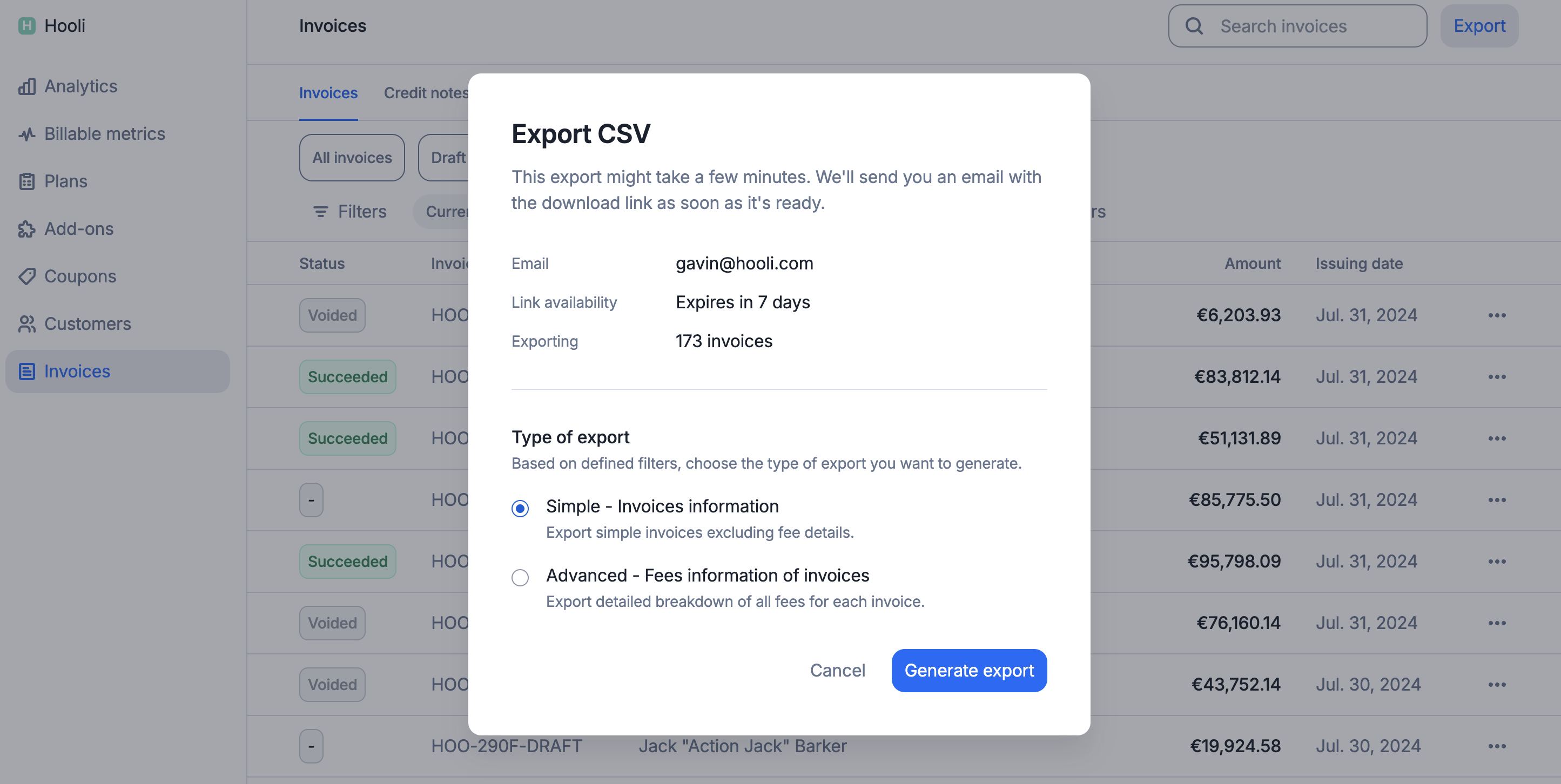
Basic invoices export in CSV
Detailed invoice fees export
The second option is an advanced invoice export. This process generates a CSV file containing one row per fee (line item of your invoices), based on the filters you have previously applied. The exported CSV includes detailed information on each fee and line item of your invoices, and is sent to the email address of the user who requested the export. The download link for the CSV file is valid for 7 days.
Advanced invoice fees export in CSV
Filter and export Credit notes
TheCredit notes list can be filtered and exported too. The behavior matches the invoice export described above, using the credit note fields.
Review a billing period for finance
Use the same export process whether a customer bought a self-serve plan or signed a negotiated agreement. Start with a single billing entity, currency, and issuing-date range so the files cover the same population.- Export invoices for one row per invoice and invoice fees for the underlying line items. Export credit notes for the same period if you issued any corrections.
- For self-serve customers, check the recurring fee, usage charges, and any plan-change adjustment against the plan and the effective date of the change. A mid-cycle upgrade can produce a prorated charge; review the actual invoice rather than assuming a full-period price.
- For negotiated customers, check the fixed fee, usage charges, and any wallet credit applied to the invoice against the agreed terms. If terms changed during the period, compare the invoice with the effective date of the subscription change.
- Review the invoice payment status separately from the billed amount. A partial payment can leave an invoice pending until it is fully settled; see record manual payments if payments were recorded outside a connected provider.