Bill negotiated minimum spend with Lago Cloud or self-hosted Lago, including annual commitments, monthly usage invoices, and an end-of-period true-up.
Premium feature ✨:This feature is only available to users with a premium license. Please contact us to get access to Lago Cloud and Lago Self-Hosted Premium.
A plan can define a minimum spending commitment for an enterprise contract. Combine it with negotiated usage rates, and override the plan for each customer. These workflows are available with managed Lago Cloud and Lago Self-Hosted Premium.Use a minimum commitment when the customer agrees to spend at least an amount over a billing period. Use prepaid credits when the customer buys a balance up front to pay future invoices. Both can be part of a negotiated offer; they represent different billing rules.
Minimum commitment
Guidelines
Besides spending minimums per charge,
you can define minimum invoice totals. A minimum commitment makes a customer
meet a minimum spend per billing period. It applies to the total spending in the
billing period, including, if applicable, the subscription fee and all
usage-based fees.
Commitment interval: The minimum commitment is aligned with the billing interval of the plan. For instance, if the plan is billed monthly, the minimum commitment is also established on a monthly basis;
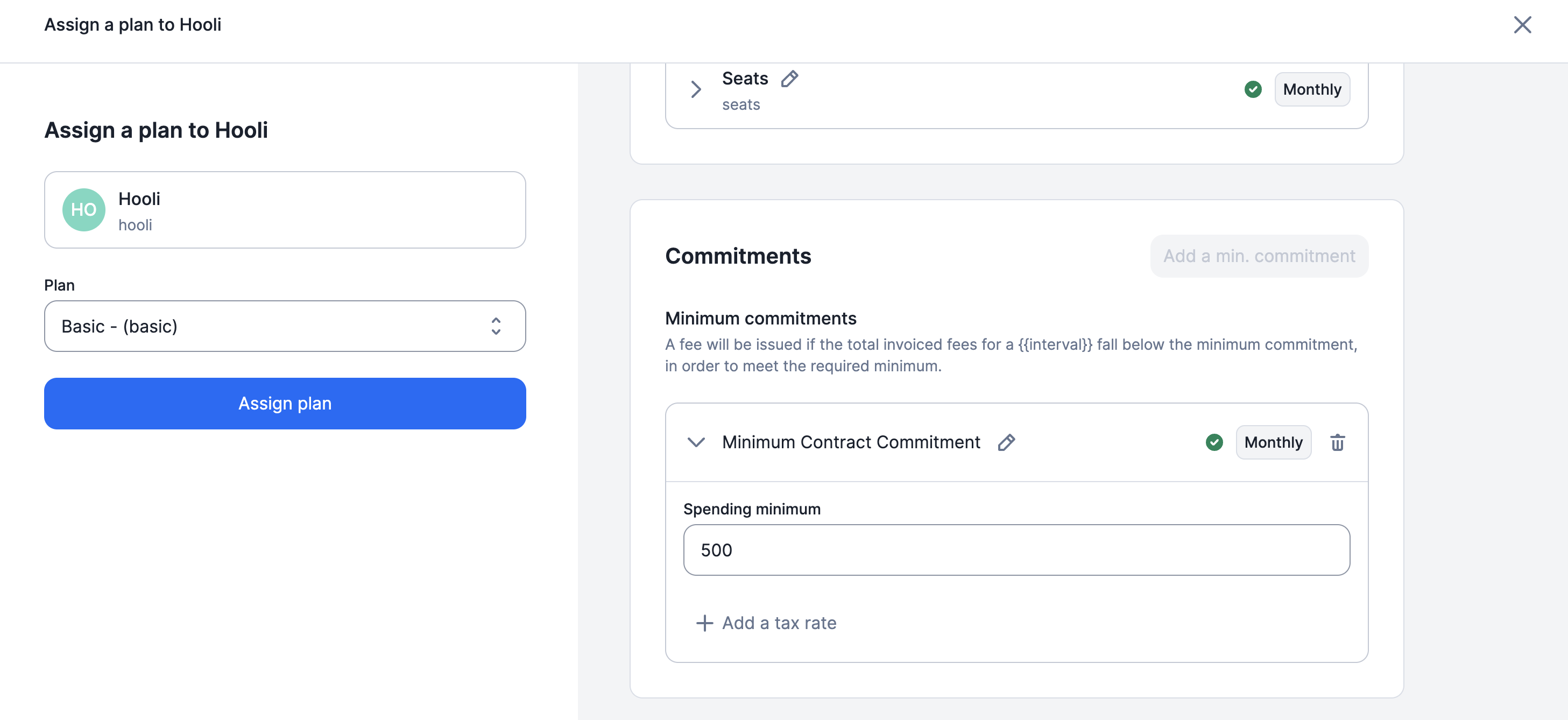
Customizable commitments: When assigning a plan to a customer, you have the option to override the default commitment. This allows for customized minimum commitments per customer, accommodating negotiated contract terms; and
Arrears calculation: The commitment is calculated in arrears, meaning Lago waits until the end of the billing period to assess whether users have met their minimum spending commitment. This approach ensures accurate billing based on actual usage.
True-up fee
If the total spending falls below the minimum commitment at the end of the billing period, Lago will apply a true-up fee to adjust the invoice and meet the minimum spending requirement.
Conversely, if spending exceeds the minimum commitment, Lago will generate an invoice for the actual consumption, without issuing a true-up fee.
The minimum commitment is calculated based on the pre-tax amount and before any discounts (such as coupons or credits) are applied.
Annual commitment with monthly usage invoices
Set the plan interval to yearly and enable monthly billing for usage-based charges (bill_charges_monthly: true). The minimum commitment follows the yearly plan interval. Lago invoices usage each month and assesses the annual shortfall at the end of the commitment period.For example, a customer starts on January 1 with a $120,000 annual minimum commitment, no subscription fee, and usage billed monthly in arrears. Assume a full calendar year with no plan changes, taxes, discounts, or credits, and $8,000 of billable usage each month:
Billing step
Amount
January through November usage invoices
11 × $8,000 = $88,000
December usage
$8,000
Annual usage total
$96,000
Year-end true-up
$120,000 − $96,000 = $24,000
Invoice closing the year
$8,000 usage + $24,000 true-up = $32,000
Total billed for the year
$120,000
If annual spending reaches or exceeds the commitment, Lago bills the actual spending without adding a true-up. A $120,000 annual minimum allows usage to vary across the year; twelve $10,000 monthly minimums assess a separate shortfall each month.For customer-specific changes, see edit a subscription. Finance can reconcile past usage, the invoice’s usage lines, and its true-up fee, then export invoices or sync them to NetSuite.
Defining a minimum commitment
Dashboard
API
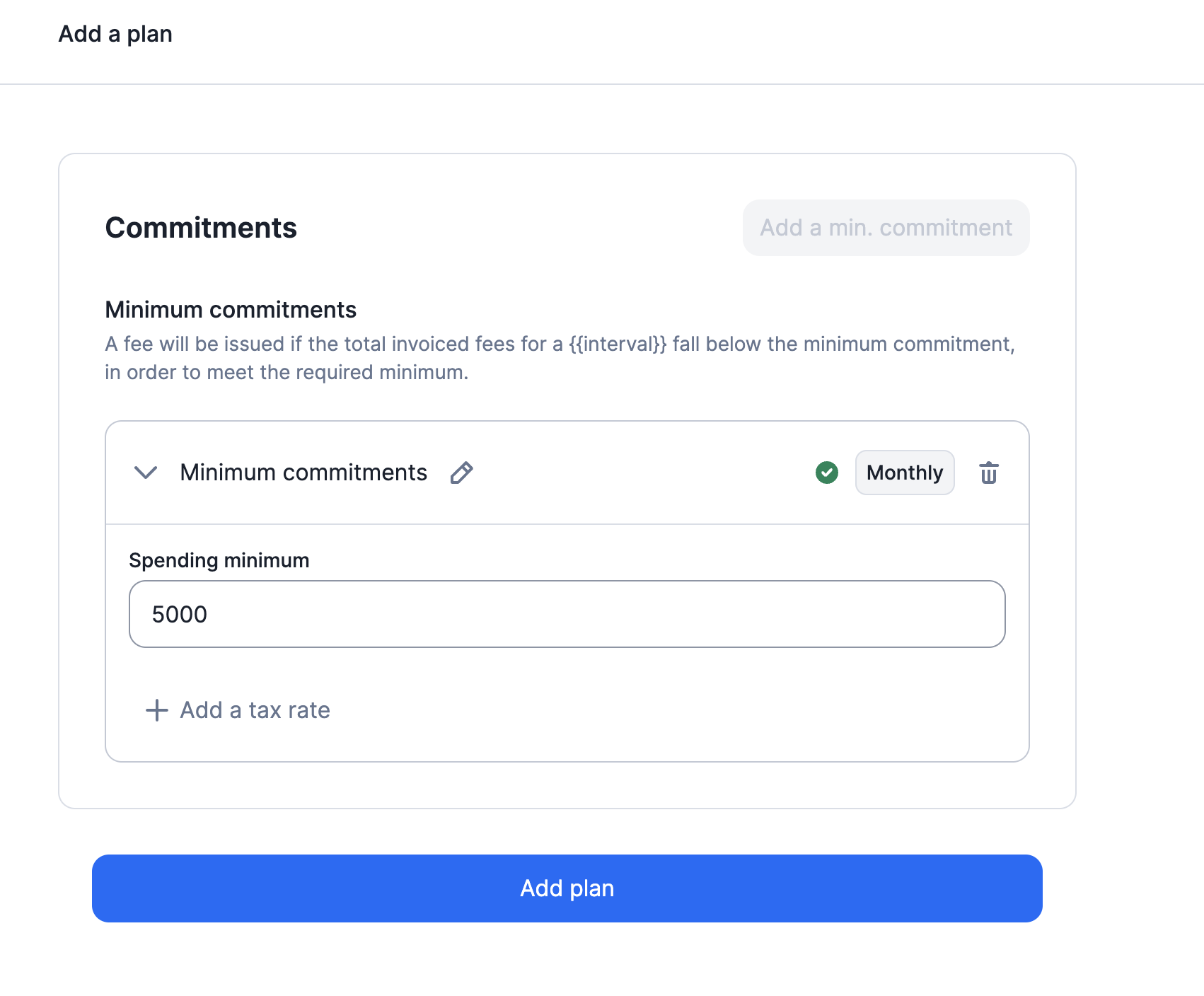
To create or update a minimum commitment from the user interface:
Open an existing plan, or create a new one;
Navigate below usage based charges;
Define a minimum commitment; and
Click “Add plan” to confirm.
Define a minimum commitment
The minimum commitment must follow the plan’s interval. You can add a specific tax rate for this minimum commitment.
{"docsConfig":{"theme":"mint","$schema":"https://mintlify.com/docs.json","name":"Lago","description":"Developer documentation for Lago, the open-source billing platform for usage metering, subscriptions, invoicing, payments, and revenue operations.","colors":{"primary":"#006CFA","light":"#006CFA","dark":"#006CFA"},"logo":{"light":"https://mintcdn.com/lago-docs/zZSJbpe68PHhSs3x/logo/light.svg?fit=max\u0026auto=format\u0026n=zZSJbpe68PHhSs3x\u0026q=85\u0026s=b4af3001527c985b81858b9a0928534c","dark":"https://mintcdn.com/lago-docs/zZSJbpe68PHhSs3x/logo/dark.svg?fit=max\u0026auto=format\u0026n=zZSJbpe68PHhSs3x\u0026q=85\u0026s=1eb7aacac796b0cc6bf05be790a792b1"},"favicon":"https://mintcdn.com/lago-docs/8N-yOElNGe9jRGG5/favicon.svg?fit=max\u0026auto=format\u0026n=8N-yOElNGe9jRGG5\u0026q=85\u0026s=5c319e58dd9b5c5b8a31cf2ad8009a1c","api":{"openapi":"https://swagger.getlago.com/openapi.yaml","mdx":{"server":"https://api.getlago.com/api/v1"}},"background":{"color":{"light":"#F5F5EF","dark":"#131923"}},"navbar":{"links":[{"href":"https://getlago.com/book-a-demo","label":"Book a Demo"}],"primary":{"type":"button","label":"Get Started","href":"https://getlago.com/book-a-demo"}},"footer":{"socials":{"github":"https://github.com/getlago/lago","slack":"https://getlago.com/slack","x":"https://x.com/getlago","linkedin":"https://www.linkedin.com/company/getlago","youtube":"https://www.youtube.com/channel/UCp6ltp7n3SgDVsmerJ7O7ZA"},"links":[{"header":"Documentation","items":[{"label":"Get started","href":"https://getlago.com/docs/guide/introduction/welcome-to-lago"},{"label":"API reference","href":"https://getlago.com/docs/api-reference/intro"},{"label":"Integrations","href":"https://getlago.com/docs/integrations/introduction"},{"label":"Templates","href":"https://getlago.com/docs/templates/introduction"},{"label":"Changelog","href":"https://getlago.com/docs/changelog/product"},{"label":"FAQ","href":"https://getlago.com/docs/faq/about-lago"}]},{"header":"Developers","items":[{"label":"Developer hub","href":"https://getlago.com/docs/developers"},{"label":"Authentication","href":"https://getlago.com/docs/auth"},{"label":"Webhooks","href":"https://getlago.com/docs/guide/webhooks"},{"label":"SDKs","href":"https://getlago.com/docs/developers"},{"label":"OpenAPI spec","href":"https://swagger.getlago.com/"},{"label":"MCP server","href":"https://getlago.com/docs/guide/ai-agents/mcp-server"},{"label":"Self-hosted","href":"https://getlago.com/docs/guide/lago-self-hosted/overview"},{"label":"llms.txt","href":"https://getlago.com/docs/llms.txt"}]},{"header":"Platform","items":[{"label":"Usage metering","href":"https://getlago.com/platform/usage-metering"},{"label":"Billing \u0026 invoicing","href":"https://getlago.com/platform/billing-invoicing"},{"label":"Cash collection","href":"https://getlago.com/platform/cash-collection"},{"label":"Revenue analytics","href":"https://getlago.com/platform/revenue-analytics"},{"label":"Entitlements","href":"https://getlago.com/platform/entitlements"},{"label":"Lago AI","href":"https://getlago.com/platform/ai"},{"label":"Pricing","href":"https://getlago.com/pricing"}]},{"header":"Company","items":[{"label":"About Lago","href":"https://getlago.com/docs/about"},{"label":"Customers","href":"https://getlago.com/customers"},{"label":"Blog","href":"https://getlago.com/blog"},{"label":"Contact","href":"https://getlago.com/docs/contact"},{"label":"Trust center","href":"https://security.getlago.com"},{"label":"Status","href":"https://status.getlago.com"}]}]},"seo":{"metatags":{"canonical":"https://getlago.com/docs","description":"Developer documentation for Lago's API-first billing platform, including OpenAPI, SDKs, webhooks, MCP, authentication, and implementation guides.","keywords":"Lago API, billing API, usage metering API, OpenAPI, billing SDK, Lago MCP"},"organization":{"id":"https://getlago.com/#organization","name":"Lago","legalName":"Get Lago Corp.","url":"https://getlago.com","logo":"https://getlago.com/docs/logo/light.svg","sameAs":["https://github.com/getlago","https://www.linkedin.com/company/getlago","https://x.com/GetLago","https://www.youtube.com/channel/UCp6ltp7n3SgDVsmerJ7O7ZA"]},"indexing":"all"},"fonts":{"heading":{"family":"GT America","weight":700,"source":"fonts/GT-America-Standard-Medium.woff2","format":"woff2"},"body":{"family":"GT America","source":"fonts/GT-America-Standard-Regular.woff2","format":"woff2"}},"styling":{"codeblocks":"dark","latex":true},"integrations":{"ga4":{"measurementId":"G-743BQ9THCG"},"cookies":{"key":"lago_docs_analytics","value":"granted"}},"errors":{"404":{"redirect":false,"title":"Documentation page not found","description":"No Lago documentation exists at this URL. Start at [Lago Developer Documentation](/welcome), browse [Developer Resources](/developers), inspect the [documentation index](/llms.txt) or [sitemap](/sitemap.xml), or search the [API reference](/api-reference/intro)."}},"contextual":{"options":["copy","view","chatgpt","claude"],"display":"header"},"navigation":{"global":{"anchors":[{"anchor":"Blog","icon":"newspaper","href":"https://getlago.com/blog"},{"anchor":"Community","icon":"slack","href":"https://getlago.com/slack"},{"anchor":"GitHub","icon":"github","href":"https://github.com/getlago/lago"},{"anchor":"Status","icon":"signal-bars","href":"https://status.getlago.com/"}]},"pages":[]}},"deployment":{"deploymentMetadataValue":{"subdomain":"lago-docs","hasAudioNarration":false,"actualSubdomain":"lago-docs","customDomains":["getlago.com"],"gitSource":{"type":"github","owner":"getlago","repo":"lago-doc","deployBranch":"main","contentDirectory":"","isPrivate":false,"mountPath":"","label":""},"feedback":{"thumbs":true,"edits":true,"issues":true},"entitlements":{"AI_CHAT":{"status":"ENABLED"},"WEB_MCP":{"status":"ENABLED"},"NARRATION":{"status":"ENABLED"}},"buildId":"6b09acb3abaa6e997b15e050","clientVersion":"0.0.4342","searchFilterCounts":[{"language":"default","tag":"API References","count":243},{"language":"default","tag":"API Reference","count":243},{"language":"default","tag":"Guide","count":208},{"language":"default","tag":"Integrations","count":56},{"language":"default","tag":"Plans","count":46},{"language":"default","tag":"Resources","count":46},{"language":"default","tag":"Charges","count":39},{"language":"default","tag":"Pricing \u0026 Subscriptions","count":35},{"language":"default","tag":"Subscriptions","count":31},{"language":"default","tag":"Events \u0026 Usage Components","count":29}]},"assistantConfig":{},"basePath":"/docs","hasChatPermissions":true,"hasWebMcpPermissions":true,"toggles":[{"name":"kill-isr","enabled":true,"variant":{"name":"disabled","enabled":false,"feature_enabled":true},"impressionData":false},{"name":"custom-rbac-roles","enabled":true,"variant":{"name":"disabled","enabled":false,"feature_enabled":true},"impressionData":false},{"name":"agent-mintlify-slack","enabled":true,"variant":{"name":"disabled","enabled":false,"feature_enabled":true},"impressionData":false},{"name":"agent-integrations-settings","enabled":true,"variant":{"name":"disabled","enabled":false,"feature_enabled":true},"impressionData":false},{"name":"rbac-expansion","enabled":true,"variant":{"name":"disabled","enabled":false,"feature_enabled":true},"impressionData":false},{"name":"automations-pr-grouping","enabled":true,"variant":{"name":"disabled","enabled":false,"feature_enabled":true},"impressionData":false},{"name":"custom-prefix","enabled":true,"variant":{"name":"disabled","enabled":false,"feature_enabled":true},"impressionData":false},{"name":"analytics-v7","enabled":true,"variant":{"name":"disabled","enabled":false,"feature_enabled":true},"impressionData":false},{"name":"user-flows-analytics","enabled":true,"variant":{"name":"disabled","enabled":false,"feature_enabled":true},"impressionData":false},{"name":"no-publish-flow","enabled":true,"variant":{"name":"disabled","enabled":false,"feature_enabled":true},"impressionData":false},{"name":"snapshot-serving-live","enabled":true,"variant":{"name":"disabled","enabled":false,"feature_enabled":true},"impressionData":false},{"name":"stripTemperatureMiddleware","enabled":true,"variant":{"name":"disabled","enabled":false,"feature_enabled":true},"impressionData":false},{"name":"support-platform-pylon-zendesk","enabled":true,"variant":{"name":"disabled","enabled":false,"feature_enabled":true},"impressionData":false},{"name":"snapshot-serving","enabled":true,"variant":{"name":"disabled","enabled":false,"feature_enabled":true},"impressionData":false},{"name":"instant-rollback","enabled":true,"variant":{"name":"disabled","enabled":false,"feature_enabled":true},"impressionData":false},{"name":"granular-notifications-server","enabled":true,"variant":{"name":"disabled","enabled":false,"feature_enabled":true},"impressionData":false},{"name":"granular-notifications","enabled":true,"variant":{"name":"disabled","enabled":false,"feature_enabled":true},"impressionData":false},{"name":"automations-fable","enabled":true,"variant":{"name":"disabled","enabled":false,"feature_enabled":true},"impressionData":false},{"name":"fixed-ai-action-pricing","enabled":true,"variant":{"name":"disabled","enabled":false,"feature_enabled":true},"impressionData":false},{"name":"site-roles","enabled":true,"variant":{"name":"disabled","enabled":false,"feature_enabled":true},"impressionData":false},{"name":"automation-resolve-merge-conflict","enabled":true,"variant":{"name":"disabled","enabled":false,"feature_enabled":true},"impressionData":false},{"name":"scoped-publishing","enabled":true,"variant":{"name":"disabled","enabled":false,"feature_enabled":true},"impressionData":false},{"name":"mintql","enabled":true,"variant":{"name":"disabled","enabled":false,"feature_enabled":true},"impressionData":false},{"name":"page-level-analytics","enabled":true,"variant":{"name":"disabled","enabled":false,"feature_enabled":true},"impressionData":false},{"name":"editor-version-history-v2","enabled":true,"variant":{"name":"disabled","enabled":false,"feature_enabled":true},"impressionData":false},{"name":"billing-page-v2","enabled":true,"variant":{"name":"disabled","enabled":false,"feature_enabled":true},"impressionData":false},{"name":"full-page-search","enabled":true,"variant":{"name":"disabled","enabled":false,"feature_enabled":true},"impressionData":false},{"name":"workspace-projects","enabled":true,"variant":{"name":"disabled","enabled":false,"feature_enabled":true},"impressionData":false},{"name":"fork-pr-previews","enabled":true,"variant":{"name":"disabled","enabled":false,"feature_enabled":true},"impressionData":false},{"name":"revalidation-jwt","enabled":true,"variant":{"name":"disabled","enabled":false,"feature_enabled":true},"impressionData":false},{"name":"hobby-abuse-scan","enabled":true,"variant":{"name":"disabled","enabled":false,"feature_enabled":true},"impressionData":false},{"name":"dashboard-inbox","enabled":true,"variant":{"name":"disabled","enabled":false,"feature_enabled":true},"impressionData":false},{"name":"turbopuffer-dual-write","enabled":true,"variant":{"name":"disabled","enabled":false,"feature_enabled":true},"impressionData":false},{"name":"approve-review-flow","enabled":true,"variant":{"name":"disabled","enabled":false,"feature_enabled":true},"impressionData":false},{"name":"editor-metadata","enabled":true,"variant":{"name":"disabled","enabled":false,"feature_enabled":true},"impressionData":false},{"name":"turbopuffer-serve","enabled":true,"variant":{"name":"disabled","enabled":false,"feature_enabled":true},"impressionData":false},{"name":"live-agents","enabled":true,"variant":{"name":"disabled","enabled":false,"feature_enabled":true},"impressionData":false},{"name":"starter-pricing","enabled":true,"variant":{"name":"treatment","enabled":true,"payload":{"type":"string","value":"treatment"},"feature_enabled":true},"impressionData":false},{"name":"llms-txt-v2","enabled":true,"variant":{"name":"disabled","enabled":false,"feature_enabled":true},"impressionData":false},{"name":"wildcard-email-auth","enabled":true,"variant":{"name":"disabled","enabled":false,"feature_enabled":true},"impressionData":false}],"starterQuestions":[],"googleFontsInlined":false},"customCss":[{"filePath":"style.css","content":"html{visibility:hidden;background-color:#F5F5EF}@media (prefers-color-scheme: dark){html{background-color:#131923}}html.ready{visibility:visible}.dark .welcome-card{background-color:#1c2535!important;border-color:rgba(255, 255, 255, 0.1)!important;box-shadow:0 1px 2px 0 rgba(0, 0, 0, 0.3)!important;color:#e5e7eb}.dark .welcome-card:hover{background-color:#243044!important}.dark .welcome-card h3{color:#ffffff}.dark .welcome-card p{color:#9ca3af!important}#changelog-month-nav{padding-left:2.5rem;width:19rem;box-sizing:border-box;margin-bottom:1.75rem;max-height:45vh;overflow-y:auto}#changelog-month-nav .changelog-month-nav__year{margin:0 0 0.5rem;font-size:0.875rem;line-height:1.5rem;font-weight:500;color:#364152}#changelog-month-nav .changelog-month-nav__list{list-style:none;margin:0;padding:0;border-left:1px solid rgba(0, 0, 0, 0.08)}#changelog-month-nav .changelog-month-nav__list a{display:block;padding:0.25rem 0 0.25rem 0.75rem;margin-left:-1px;border-left:1px solid transparent;font-size:0.875rem;line-height:1.5rem;color:#697586;text-decoration:none;transition:color 0.15s ease, border-color 0.15s ease}#changelog-month-nav .changelog-month-nav__list a:hover{color:#121926}#changelog-month-nav .changelog-month-nav__list a.is-active{color:#006CFA;border-left-color:#006CFA;font-weight:500}.dark #changelog-month-nav .changelog-month-nav__year{color:#cdd5df}.dark #changelog-month-nav .changelog-month-nav__list{border-left-color:rgba(255, 255, 255, 0.12)}.dark #changelog-month-nav .changelog-month-nav__list a{color:#9aa4b2}.dark #changelog-month-nav .changelog-month-nav__list a:hover{color:#ffffff}.dark #changelog-month-nav .changelog-month-nav__list a.is-active{color:#4d9bff;border-left-color:#4d9bff}.update-container>div:first-child{display:none}.update-container>div:nth-child(2){flex:1 1 100%;max-width:100%;width:100%}.update-container{gap:0}#footer a[href*=\"utm_campaign=poweredBy\"]{display:none}"}]}
{"page":{"pagePath":"guide/plans/commitment","slug":"/guide/plans/commitment","pageMetadata":{"title":"Commitments","description":"Bill negotiated minimum spend with Lago Cloud or self-hosted Lago, including annual commitments, monthly usage invoices, and an end-of-period true-up.","href":"/guide/plans/commitment"},"description":{"compiledSource":"\"use strict\";\nconst {jsx: _jsx} = arguments[0];\nconst {useMDXComponents: _provideComponents} = arguments[0];\nfunction _createMdxContent(props) {\n const _components = {\n p: \"p\",\n ..._provideComponents(),\n ...props.components\n };\n return _jsx(_components.p, {\n children: \"Bill negotiated minimum spend with Lago Cloud or self-hosted Lago, including annual commitments, monthly usage invoices, and an end-of-period true-up.\"\n });\n}\nfunction MDXContent(props = {}) {\n const {wrapper: MDXLayout} = {\n ..._provideComponents(),\n ...props.components\n };\n return MDXLayout ? _jsx(MDXLayout, {\n ...props,\n children: _jsx(_createMdxContent, {\n ...props\n })\n }) : _createMdxContent(props);\n}\nreturn {\n default: MDXContent\n};\n","frontmatter":{},"scope":{}},"pageType":"default","mdx":{"mdxSource":{"compiledSource":"\"use strict\";const{Fragment:_Fragment,jsx:_jsx,jsxs:_jsxs}=arguments[0];const{useMDXComponents:_provideComponents}=arguments[0];function _createMdxContent(props){const _components={a:`a`,code:`code`,li:`li`,ol:`ol`,p:`p`,pre:`pre`,span:`span`,strong:`strong`,tbody:`tbody`,td:`td`,th:`th`,thead:`thead`,tr:`tr`,ul:`ul`,..._provideComponents(),...props.components},{CodeBlock,CodeGroup,Frame,Heading,Info,OptimizedImage,Tab,Table,Tabs}=_components;if(!CodeBlock)_missingMdxReference(`CodeBlock`,true);if(!CodeGroup)_missingMdxReference(`CodeGroup`,true);if(!Frame)_missingMdxReference(`Frame`,true);if(!Heading)_missingMdxReference(`Heading`,true);if(!Info)_missingMdxReference(`Info`,true);if(!OptimizedImage)_missingMdxReference(`OptimizedImage`,true);if(!Tab)_missingMdxReference(`Tab`,true);if(!Table)_missingMdxReference(`Table`,true);if(!Tabs)_missingMdxReference(`Tabs`,true);return _jsxs(_Fragment,{children:[_jsxs(Info,{children:[_jsxs(_components.p,{children:[_jsx(_components.strong,{children:`Premium feature ✨`}),`:`]}),_jsxs(_components.p,{children:[`This feature is only available to users with a premium license. Please `,_jsx(_components.strong,{children:_jsx(_components.a,{href:`mailto:hello@getlago.com`,children:`contact us`})}),` to get access to Lago Cloud and Lago Self-Hosted Premium.`]})]}),`\n`,_jsxs(_components.p,{children:[`A plan can define a minimum spending commitment for an enterprise contract. Combine it with negotiated usage rates, and `,_jsx(_components.a,{href:`/guide/subscriptions/assign-plan#overriding-a-plan`,children:`override the plan for each customer`}),`. These workflows are available with managed `,_jsx(_components.a,{href:`/guide/lago-cloud`,children:`Lago Cloud`}),` and Lago Self-Hosted Premium.`]}),`\n`,_jsxs(_components.p,{children:[`Use a minimum commitment when the customer agrees to spend at least an amount over a billing period. Use `,_jsx(_components.a,{href:`/guide/wallet-and-prepaid-credits/overview`,children:`prepaid credits`}),` when the customer buys a balance up front to pay future invoices. Both can be part of a negotiated offer; they represent different billing rules.`]}),`\n`,_jsx(Heading,{level:`2`,id:`minimum-commitment`,children:`Minimum commitment`}),`\n`,_jsx(Heading,{level:`3`,id:`guidelines`,children:`Guidelines`}),`\n`,_jsxs(_components.p,{children:[`Besides `,_jsx(_components.a,{href:`/guide/plans/charges/spending-minimum`,children:`spending minimums per charge`}),`,\nyou can define minimum invoice totals. A minimum commitment makes a customer\nmeet a minimum spend per billing period. It applies to the total spending in the\nbilling period, including, if applicable, the subscription fee and all\nusage-based fees.`]}),`\n`,_jsxs(_components.ul,{children:[`\n`,_jsxs(_components.li,{children:[_jsx(_components.strong,{children:`Commitment interval:`}),` The minimum commitment is aligned with the billing interval of the plan. For instance, if the plan is billed monthly, the minimum commitment is also established on a monthly basis;`]}),`\n`,_jsxs(_components.li,{children:[_jsx(_components.strong,{children:`Customizable commitments:`}),` When assigning a plan to a customer, you have the option to override the default commitment. This allows for customized minimum commitments per customer, accommodating negotiated contract terms; and`]}),`\n`,_jsxs(_components.li,{children:[_jsx(_components.strong,{children:`Arrears calculation:`}),` The commitment is calculated in arrears, meaning Lago waits until the end of the billing period to assess whether users have met their minimum spending commitment. This approach ensures accurate billing based on actual usage.`]}),`\n`]}),`\n`,_jsx(Heading,{level:`3`,id:`true-up-fee`,children:`True-up fee`}),`\n`,_jsxs(_components.p,{children:[`If the total spending falls below the minimum commitment at the end of the billing period, Lago will `,_jsx(_components.strong,{children:`apply a true-up fee to adjust the invoice and meet the minimum spending requirement`}),`.\nConversely, if spending exceeds the minimum commitment, Lago will generate an invoice for the actual consumption, without issuing a true-up fee.`]}),`\n`,_jsx(Info,{children:_jsx(_components.p,{children:`The minimum commitment is calculated based on the pre-tax amount and before any discounts (such as coupons or credits) are applied.`})}),`\n`,_jsx(Heading,{level:`3`,id:`annual-commitment-with-monthly-usage-invoices`,children:`Annual commitment with monthly usage invoices`}),`\n`,_jsxs(_components.p,{children:[`Set the `,_jsx(_components.a,{href:`/guide/plans/plan-model#plan-interval`,children:`plan interval`}),` to `,_jsx(_components.code,{children:`yearly`}),` and enable monthly billing for usage-based charges (`,_jsx(_components.code,{children:`bill_charges_monthly: true`}),`). The minimum commitment follows the yearly plan interval. Lago invoices usage each month and assesses the annual shortfall at the end of the commitment period.`]}),`\n`,_jsxs(_components.p,{children:[`For example, a customer starts on January 1 with a `,_jsx(_components.strong,{children:`$120,000 annual minimum commitment`}),`, no subscription fee, and usage billed monthly in arrears. Assume a full calendar year with no plan changes, taxes, discounts, or credits, and $8,000 of billable usage each month:`]}),`\n`,_jsxs(Table,{children:[_jsx(_components.thead,{children:_jsxs(_components.tr,{children:[_jsx(_components.th,{children:`Billing step`}),_jsx(_components.th,{style:{textAlign:`right`},children:`Amount`})]})}),_jsxs(_components.tbody,{children:[_jsxs(_components.tr,{children:[_jsx(_components.td,{children:`January through November usage invoices`}),_jsx(_components.td,{\"data-numeric\":`true`,style:{textAlign:`right`},children:`11 × $8,000 = $88,000`})]}),_jsxs(_components.tr,{children:[_jsx(_components.td,{children:`December usage`}),_jsx(_components.td,{\"data-numeric\":`true`,style:{textAlign:`right`},children:`$8,000`})]}),_jsxs(_components.tr,{children:[_jsx(_components.td,{children:`Annual usage total`}),_jsx(_components.td,{\"data-numeric\":`true`,style:{textAlign:`right`},children:`$96,000`})]}),_jsxs(_components.tr,{children:[_jsx(_components.td,{children:`Year-end true-up`}),_jsx(_components.td,{\"data-numeric\":`true`,style:{textAlign:`right`},children:`$120,000 − $96,000 = $24,000`})]}),_jsxs(_components.tr,{children:[_jsx(_components.td,{children:`Invoice closing the year`}),_jsx(_components.td,{style:{textAlign:`right`},children:`$8,000 usage + $24,000 true-up = $32,000`})]}),_jsxs(_components.tr,{children:[_jsx(_components.td,{children:`Total billed for the year`}),_jsx(_components.td,{\"data-numeric\":`true`,style:{textAlign:`right`},children:`$120,000`})]})]})]}),`\n`,_jsx(_components.p,{children:`If annual spending reaches or exceeds the commitment, Lago bills the actual spending without adding a true-up. A $120,000 annual minimum allows usage to vary across the year; twelve $10,000 monthly minimums assess a separate shortfall each month.`}),`\n`,_jsxs(_components.p,{children:[`For customer-specific changes, see `,_jsx(_components.a,{href:`/guide/subscriptions/edit-subscription`,children:`edit a subscription`}),`. Finance can reconcile `,_jsx(_components.a,{href:`/guide/events/retrieve-usage`,children:`past usage`}),`, the invoice’s usage lines, and its true-up fee, then `,_jsx(_components.a,{href:`/guide/invoicing/export`,children:`export invoices`}),` or sync them to `,_jsx(_components.a,{href:`/integrations/accounting/netsuite`,children:`NetSuite`}),`.`]}),`\n`,_jsx(Heading,{level:`3`,id:`defining-a-minimum-commitment`,children:`Defining a minimum commitment`}),`\n`,_jsxs(Tabs,{children:[_jsxs(Tab,{title:`Dashboard`,id:`dashboard`,children:[_jsx(_components.p,{children:`To create or update a minimum commitment from the user interface:`}),_jsxs(_components.ol,{children:[`\n`,_jsx(_components.li,{children:`Open an existing plan, or create a new one;`}),`\n`,_jsx(_components.li,{children:`Navigate below usage based charges;`}),`\n`,_jsxs(_components.li,{children:[`Define a `,_jsx(_components.strong,{children:`minimum commitment`}),`; and`]}),`\n`,_jsxs(_components.li,{children:[`Click `,_jsx(_components.strong,{children:`“Add plan”`}),` to confirm.`]}),`\n`]}),_jsx(Frame,{caption:`Define a minimum commitment`,children:_jsx(OptimizedImage,{src:`https://mintcdn.com/lago-docs/x0ux42rCkjpwz1jk/guide/payments/images/minimum-commitment-on-plan.png?fit=max\u0026auto=format\u0026n=x0ux42rCkjpwz1jk\u0026q=85\u0026s=7c4d75015b62584cea23adf8fb51c4f0`,alt:`Defining a minimum commitment on a plan in the Lago dashboard`,\"data-og-width\":`1702`,width:`1702`,\"data-og-height\":`1408`,height:`1408`,\"data-path\":`guide/payments/images/minimum-commitment-on-plan.png`,\"data-optimize\":`true`,\"data-opv\":`3`,srcset:`https://mintcdn.com/lago-docs/x0ux42rCkjpwz1jk/guide/payments/images/minimum-commitment-on-plan.png?w=280\u0026fit=max\u0026auto=format\u0026n=x0ux42rCkjpwz1jk\u0026q=85\u0026s=35bda87f1ea6af29729f7fe975f0af9d 280w, https://mintcdn.com/lago-docs/x0ux42rCkjpwz1jk/guide/payments/images/minimum-commitment-on-plan.png?w=560\u0026fit=max\u0026auto=format\u0026n=x0ux42rCkjpwz1jk\u0026q=85\u0026s=29b48e8f7da42bff66fd32efeae9071f 560w, https://mintcdn.com/lago-docs/x0ux42rCkjpwz1jk/guide/payments/images/minimum-commitment-on-plan.png?w=840\u0026fit=max\u0026auto=format\u0026n=x0ux42rCkjpwz1jk\u0026q=85\u0026s=a9d5612f2503bb65a63f2f375d69144e 840w, https://mintcdn.com/lago-docs/x0ux42rCkjpwz1jk/guide/payments/images/minimum-commitment-on-plan.png?w=1100\u0026fit=max\u0026auto=format\u0026n=x0ux42rCkjpwz1jk\u0026q=85\u0026s=627421fb9618453e1bf232e8a6877e5d 1100w, https://mintcdn.com/lago-docs/x0ux42rCkjpwz1jk/guide/payments/images/minimum-commitment-on-plan.png?w=1650\u0026fit=max\u0026auto=format\u0026n=x0ux42rCkjpwz1jk\u0026q=85\u0026s=e3805690b2b5212615ff368994e11294 1650w, https://mintcdn.com/lago-docs/x0ux42rCkjpwz1jk/guide/payments/images/minimum-commitment-on-plan.png?w=2500\u0026fit=max\u0026auto=format\u0026n=x0ux42rCkjpwz1jk\u0026q=85\u0026s=fb4089f730a6a97a9af524127726df27 2500w`})}),_jsx(Info,{children:_jsx(_components.p,{children:`The minimum commitment must follow the plan’s interval. You can add a specific tax rate for this minimum commitment.`})})]}),_jsx(Tab,{title:`API`,id:`api`,children:_jsx(CodeGroup,{children:_jsx(CodeBlock,{filename:`Define a minimum commitment`,highlight:`[16,17,18,19,20,21,22]`,numberOfLines:`60`,language:`json`,children:_jsx(_components.pre,{className:`shiki shiki-themes dark-plus dark-plus`,style:{backgroundColor:`#0B0C0E`,\"--shiki-dark-bg\":`#0B0C0E`,color:`#D4D4D4`,\"--shiki-dark\":`#D4D4D4`},language:`json`,children:_jsxs(_components.code,{language:`json`,numberOfLines:`60`,children:[_jsx(_components.span,{className:`line`,children:_jsx(_components.span,{style:{color:`#D4D4D4`,\"--shiki-dark\":`#D4D4D4`},children:`{`})}),`\n`,_jsxs(_components.span,{className:`line`,children:[_jsx(_components.span,{style:{color:`#9CDCFE`,\"--shiki-dark\":`#9CDCFE`},children:` \"plan\"`}),_jsx(_components.span,{style:{color:`#D4D4D4`,\"--shiki-dark\":`#D4D4D4`},children:`: {`})]}),`\n`,_jsxs(_components.span,{className:`line`,children:[_jsx(_components.span,{style:{color:`#9CDCFE`,\"--shiki-dark\":`#9CDCFE`},children:` \"name\"`}),_jsx(_components.span,{style:{color:`#D4D4D4`,\"--shiki-dark\":`#D4D4D4`},children:`: `}),_jsx(_components.span,{style:{color:`#CE9178`,\"--shiki-dark\":`#CE9178`},children:`\"Basic\"`}),_jsx(_components.span,{style:{color:`#D4D4D4`,\"--shiki-dark\":`#D4D4D4`},children:`,`})]}),`\n`,_jsxs(_components.span,{className:`line`,children:[_jsx(_components.span,{style:{color:`#9CDCFE`,\"--shiki-dark\":`#9CDCFE`},children:` \"invoice_display_name\"`}),_jsx(_components.span,{style:{color:`#D4D4D4`,\"--shiki-dark\":`#D4D4D4`},children:`: `}),_jsx(_components.span,{style:{color:`#569CD6`,\"--shiki-dark\":`#569CD6`},children:`null`}),_jsx(_components.span,{style:{color:`#D4D4D4`,\"--shiki-dark\":`#D4D4D4`},children:`,`})]}),`\n`,_jsxs(_components.span,{className:`line`,children:[_jsx(_components.span,{style:{color:`#9CDCFE`,\"--shiki-dark\":`#9CDCFE`},children:` \"created_at\"`}),_jsx(_components.span,{style:{color:`#D4D4D4`,\"--shiki-dark\":`#D4D4D4`},children:`: `}),_jsx(_components.span,{style:{color:`#CE9178`,\"--shiki-dark\":`#CE9178`},children:`\"2024-02-23T16:01:04Z\"`}),_jsx(_components.span,{style:{color:`#D4D4D4`,\"--shiki-dark\":`#D4D4D4`},children:`,`})]}),`\n`,_jsxs(_components.span,{className:`line`,children:[_jsx(_components.span,{style:{color:`#9CDCFE`,\"--shiki-dark\":`#9CDCFE`},children:` \"code\"`}),_jsx(_components.span,{style:{color:`#D4D4D4`,\"--shiki-dark\":`#D4D4D4`},children:`: `}),_jsx(_components.span,{style:{color:`#CE9178`,\"--shiki-dark\":`#CE9178`},children:`\"basic\"`}),_jsx(_components.span,{style:{color:`#D4D4D4`,\"--shiki-dark\":`#D4D4D4`},children:`,`})]}),`\n`,_jsxs(_components.span,{className:`line`,children:[_jsx(_components.span,{style:{color:`#9CDCFE`,\"--shiki-dark\":`#9CDCFE`},children:` \"interval\"`}),_jsx(_components.span,{style:{color:`#D4D4D4`,\"--shiki-dark\":`#D4D4D4`},children:`: `}),_jsx(_components.span,{style:{color:`#CE9178`,\"--shiki-dark\":`#CE9178`},children:`\"monthly\"`}),_jsx(_components.span,{style:{color:`#D4D4D4`,\"--shiki-dark\":`#D4D4D4`},children:`,`})]}),`\n`,_jsxs(_components.span,{className:`line`,children:[_jsx(_components.span,{style:{color:`#9CDCFE`,\"--shiki-dark\":`#9CDCFE`},children:` \"description\"`}),_jsx(_components.span,{style:{color:`#D4D4D4`,\"--shiki-dark\":`#D4D4D4`},children:`: `}),_jsx(_components.span,{style:{color:`#CE9178`,\"--shiki-dark\":`#CE9178`},children:`\"\"`}),_jsx(_components.span,{style:{color:`#D4D4D4`,\"--shiki-dark\":`#D4D4D4`},children:`, `})]}),`\n`,_jsxs(_components.span,{className:`line`,children:[_jsx(_components.span,{style:{color:`#9CDCFE`,\"--shiki-dark\":`#9CDCFE`},children:` \"amount_cents\"`}),_jsx(_components.span,{style:{color:`#D4D4D4`,\"--shiki-dark\":`#D4D4D4`},children:`: `}),_jsx(_components.span,{style:{color:`#B5CEA8`,\"--shiki-dark\":`#B5CEA8`},children:`10000`}),_jsx(_components.span,{style:{color:`#D4D4D4`,\"--shiki-dark\":`#D4D4D4`},children:`,`})]}),`\n`,_jsxs(_components.span,{className:`line`,children:[_jsx(_components.span,{style:{color:`#9CDCFE`,\"--shiki-dark\":`#9CDCFE`},children:` \"pay_in_advance\"`}),_jsx(_components.span,{style:{color:`#D4D4D4`,\"--shiki-dark\":`#D4D4D4`},children:`: `}),_jsx(_components.span,{style:{color:`#569CD6`,\"--shiki-dark\":`#569CD6`},children:`true`}),_jsx(_components.span,{style:{color:`#D4D4D4`,\"--shiki-dark\":`#D4D4D4`},children:`,`})]}),`\n`,_jsxs(_components.span,{className:`line`,children:[_jsx(_components.span,{style:{color:`#9CDCFE`,\"--shiki-dark\":`#9CDCFE`},children:` \"bill_charges_monthly\"`}),_jsx(_components.span,{style:{color:`#D4D4D4`,\"--shiki-dark\":`#D4D4D4`},children:`: `}),_jsx(_components.span,{style:{color:`#569CD6`,\"--shiki-dark\":`#569CD6`},children:`null`}),_jsx(_components.span,{style:{color:`#D4D4D4`,\"--shiki-dark\":`#D4D4D4`},children:`,`})]}),`\n`,_jsxs(_components.span,{className:`line`,children:[_jsx(_components.span,{style:{color:`#9CDCFE`,\"--shiki-dark\":`#9CDCFE`},children:` \"customers_count\"`}),_jsx(_components.span,{style:{color:`#D4D4D4`,\"--shiki-dark\":`#D4D4D4`},children:`: `}),_jsx(_components.span,{style:{color:`#B5CEA8`,\"--shiki-dark\":`#B5CEA8`},children:`2`}),_jsx(_components.span,{style:{color:`#D4D4D4`,\"--shiki-dark\":`#D4D4D4`},children:`,`})]}),`\n`,_jsxs(_components.span,{className:`line`,children:[_jsx(_components.span,{style:{color:`#9CDCFE`,\"--shiki-dark\":`#9CDCFE`},children:` \"active_subscriptions_count\"`}),_jsx(_components.span,{style:{color:`#D4D4D4`,\"--shiki-dark\":`#D4D4D4`},children:`: `}),_jsx(_components.span,{style:{color:`#B5CEA8`,\"--shiki-dark\":`#B5CEA8`},children:`2`}),_jsx(_components.span,{style:{color:`#D4D4D4`,\"--shiki-dark\":`#D4D4D4`},children:`,`})]}),`\n`,_jsxs(_components.span,{className:`line`,children:[_jsx(_components.span,{style:{color:`#9CDCFE`,\"--shiki-dark\":`#9CDCFE`},children:` \"draft_invoices_count\"`}),_jsx(_components.span,{style:{color:`#D4D4D4`,\"--shiki-dark\":`#D4D4D4`},children:`: `}),_jsx(_components.span,{style:{color:`#B5CEA8`,\"--shiki-dark\":`#B5CEA8`},children:`0`}),_jsx(_components.span,{style:{color:`#D4D4D4`,\"--shiki-dark\":`#D4D4D4`},children:`,`})]}),`\n`,_jsxs(_components.span,{className:`line`,children:[_jsx(_components.span,{style:{color:`#9CDCFE`,\"--shiki-dark\":`#9CDCFE`},children:` \"parent_id\"`}),_jsx(_components.span,{style:{color:`#D4D4D4`,\"--shiki-dark\":`#D4D4D4`},children:`: `}),_jsx(_components.span,{style:{color:`#569CD6`,\"--shiki-dark\":`#569CD6`},children:`null`}),_jsx(_components.span,{style:{color:`#D4D4D4`,\"--shiki-dark\":`#D4D4D4`},children:`,`})]}),`\n`,_jsxs(_components.span,{className:`line line-highlight`,children:[_jsx(_components.span,{style:{color:`#9CDCFE`,\"--shiki-dark\":`#9CDCFE`},children:` \"minimum_commitment\"`}),_jsx(_components.span,{style:{color:`#D4D4D4`,\"--shiki-dark\":`#D4D4D4`},children:`: {`})]}),`\n`,_jsxs(_components.span,{className:`line line-highlight`,children:[_jsx(_components.span,{style:{color:`#9CDCFE`,\"--shiki-dark\":`#9CDCFE`},children:` \"plan_code\"`}),_jsx(_components.span,{style:{color:`#D4D4D4`,\"--shiki-dark\":`#D4D4D4`},children:`: `}),_jsx(_components.span,{style:{color:`#CE9178`,\"--shiki-dark\":`#CE9178`},children:`\"basic\"`}),_jsx(_components.span,{style:{color:`#D4D4D4`,\"--shiki-dark\":`#D4D4D4`},children:`,`})]}),`\n`,_jsxs(_components.span,{className:`line line-highlight`,children:[_jsx(_components.span,{style:{color:`#9CDCFE`,\"--shiki-dark\":`#9CDCFE`},children:` \"invoice_display_name\"`}),_jsx(_components.span,{style:{color:`#D4D4D4`,\"--shiki-dark\":`#D4D4D4`},children:`: `}),_jsx(_components.span,{style:{color:`#CE9178`,\"--shiki-dark\":`#CE9178`},children:`\"Minimum Contract Commitment\"`}),_jsx(_components.span,{style:{color:`#D4D4D4`,\"--shiki-dark\":`#D4D4D4`},children:`,`})]}),`\n`,_jsxs(_components.span,{className:`line line-highlight`,children:[_jsx(_components.span,{style:{color:`#9CDCFE`,\"--shiki-dark\":`#9CDCFE`},children:` \"amount_cents\"`}),_jsx(_components.span,{style:{color:`#D4D4D4`,\"--shiki-dark\":`#D4D4D4`},children:`: `}),_jsx(_components.span,{style:{color:`#B5CEA8`,\"--shiki-dark\":`#B5CEA8`},children:`50000`}),_jsx(_components.span,{style:{color:`#D4D4D4`,\"--shiki-dark\":`#D4D4D4`},children:`,`})]}),`\n`,_jsxs(_components.span,{className:`line line-highlight`,children:[_jsx(_components.span,{style:{color:`#9CDCFE`,\"--shiki-dark\":`#9CDCFE`},children:` \"interval\"`}),_jsx(_components.span,{style:{color:`#D4D4D4`,\"--shiki-dark\":`#D4D4D4`},children:`: `}),_jsx(_components.span,{style:{color:`#CE9178`,\"--shiki-dark\":`#CE9178`},children:`\"monthly\"`}),_jsx(_components.span,{style:{color:`#D4D4D4`,\"--shiki-dark\":`#D4D4D4`},children:`,`})]}),`\n`,_jsxs(_components.span,{className:`line line-highlight`,children:[_jsx(_components.span,{style:{color:`#9CDCFE`,\"--shiki-dark\":`#9CDCFE`},children:` \"taxes\"`}),_jsx(_components.span,{style:{color:`#D4D4D4`,\"--shiki-dark\":`#D4D4D4`},children:`: []`})]}),`\n`,_jsx(_components.span,{className:`line line-highlight`,children:_jsx(_components.span,{style:{color:`#D4D4D4`,\"--shiki-dark\":`#D4D4D4`},children:` },`})}),`\n`,_jsxs(_components.span,{className:`line`,children:[_jsx(_components.span,{style:{color:`#9CDCFE`,\"--shiki-dark\":`#9CDCFE`},children:` \"charges\"`}),_jsx(_components.span,{style:{color:`#D4D4D4`,\"--shiki-dark\":`#D4D4D4`},children:`: [`})]}),`\n`,_jsx(_components.span,{className:`line`,children:_jsx(_components.span,{style:{color:`#D4D4D4`,\"--shiki-dark\":`#D4D4D4`},children:` {`})}),`\n`,_jsxs(_components.span,{className:`line`,children:[_jsx(_components.span,{style:{color:`#9CDCFE`,\"--shiki-dark\":`#9CDCFE`},children:` \"id\"`}),_jsx(_components.span,{style:{color:`#D4D4D4`,\"--shiki-dark\":`#D4D4D4`},children:`: `}),_jsx(_components.span,{style:{color:`#CE9178`,\"--shiki-dark\":`#CE9178`},children:`\"ca205886-cf09-4e42-aed6-34cb2afd0c29\"`}),_jsx(_components.span,{style:{color:`#D4D4D4`,\"--shiki-dark\":`#D4D4D4`},children:`,`})]}),`\n`,_jsxs(_components.span,{className:`line`,children:[_jsx(_components.span,{style:{color:`#9CDCFE`,\"--shiki-dark\":`#9CDCFE`},children:` \"billable_metric_id\"`}),_jsx(_components.span,{style:{color:`#D4D4D4`,\"--shiki-dark\":`#D4D4D4`},children:`: `}),_jsx(_components.span,{style:{color:`#CE9178`,\"--shiki-dark\":`#CE9178`},children:`\"5b320600-715b-4ef5-88c1-4f88c0ec5c50\"`}),_jsx(_components.span,{style:{color:`#D4D4D4`,\"--shiki-dark\":`#D4D4D4`},children:`,`})]}),`\n`,_jsxs(_components.span,{className:`line`,children:[_jsx(_components.span,{style:{color:`#9CDCFE`,\"--shiki-dark\":`#9CDCFE`},children:` \"invoice_display_name\"`}),_jsx(_components.span,{style:{color:`#D4D4D4`,\"--shiki-dark\":`#D4D4D4`},children:`: `}),_jsx(_components.span,{style:{color:`#CE9178`,\"--shiki-dark\":`#CE9178`},children:`\"\"`}),_jsx(_components.span,{style:{color:`#D4D4D4`,\"--shiki-dark\":`#D4D4D4`},children:`,`})]}),`\n`,_jsxs(_components.span,{className:`line`,children:[_jsx(_components.span,{style:{color:`#9CDCFE`,\"--shiki-dark\":`#9CDCFE`},children:` \"billable_metric_code\"`}),_jsx(_components.span,{style:{color:`#D4D4D4`,\"--shiki-dark\":`#D4D4D4`},children:`: `}),_jsx(_components.span,{style:{color:`#CE9178`,\"--shiki-dark\":`#CE9178`},children:`\"storage\"`}),_jsx(_components.span,{style:{color:`#D4D4D4`,\"--shiki-dark\":`#D4D4D4`},children:`,`})]}),`\n`,_jsxs(_components.span,{className:`line`,children:[_jsx(_components.span,{style:{color:`#9CDCFE`,\"--shiki-dark\":`#9CDCFE`},children:` \"created_at\"`}),_jsx(_components.span,{style:{color:`#D4D4D4`,\"--shiki-dark\":`#D4D4D4`},children:`: `}),_jsx(_components.span,{style:{color:`#CE9178`,\"--shiki-dark\":`#CE9178`},children:`\"2024-02-23T16:01:04Z\"`}),_jsx(_components.span,{style:{color:`#D4D4D4`,\"--shiki-dark\":`#D4D4D4`},children:`,`})]}),`\n`,_jsxs(_components.span,{className:`line`,children:[_jsx(_components.span,{style:{color:`#9CDCFE`,\"--shiki-dark\":`#9CDCFE`},children:` \"charge_model\"`}),_jsx(_components.span,{style:{color:`#D4D4D4`,\"--shiki-dark\":`#D4D4D4`},children:`: `}),_jsx(_components.span,{style:{color:`#CE9178`,\"--shiki-dark\":`#CE9178`},children:`\"standard\"`}),_jsx(_components.span,{style:{color:`#D4D4D4`,\"--shiki-dark\":`#D4D4D4`},children:`,`})]}),`\n`,_jsxs(_components.span,{className:`line`,children:[_jsx(_components.span,{style:{color:`#9CDCFE`,\"--shiki-dark\":`#9CDCFE`},children:` \"invoiceable\"`}),_jsx(_components.span,{style:{color:`#D4D4D4`,\"--shiki-dark\":`#D4D4D4`},children:`: `}),_jsx(_components.span,{style:{color:`#569CD6`,\"--shiki-dark\":`#569CD6`},children:`true`}),_jsx(_components.span,{style:{color:`#D4D4D4`,\"--shiki-dark\":`#D4D4D4`},children:`,`})]}),`\n`,_jsxs(_components.span,{className:`line`,children:[_jsx(_components.span,{style:{color:`#9CDCFE`,\"--shiki-dark\":`#9CDCFE`},children:` \"pay_in_advance\"`}),_jsx(_components.span,{style:{color:`#D4D4D4`,\"--shiki-dark\":`#D4D4D4`},children:`: `}),_jsx(_components.span,{style:{color:`#569CD6`,\"--shiki-dark\":`#569CD6`},children:`false`}),_jsx(_components.span,{style:{color:`#D4D4D4`,\"--shiki-dark\":`#D4D4D4`},children:`,`})]}),`\n`,_jsxs(_components.span,{className:`line`,children:[_jsx(_components.span,{style:{color:`#9CDCFE`,\"--shiki-dark\":`#9CDCFE`},children:` \"prorated\"`}),_jsx(_components.span,{style:{color:`#D4D4D4`,\"--shiki-dark\":`#D4D4D4`},children:`: `}),_jsx(_components.span,{style:{color:`#569CD6`,\"--shiki-dark\":`#569CD6`},children:`false`}),_jsx(_components.span,{style:{color:`#D4D4D4`,\"--shiki-dark\":`#D4D4D4`},children:`,`})]}),`\n`,_jsxs(_components.span,{className:`line`,children:[_jsx(_components.span,{style:{color:`#9CDCFE`,\"--shiki-dark\":`#9CDCFE`},children:` \"properties\"`}),_jsx(_components.span,{style:{color:`#D4D4D4`,\"--shiki-dark\":`#D4D4D4`},children:`: {`})]}),`\n`,_jsxs(_components.span,{className:`line`,children:[_jsx(_components.span,{style:{color:`#9CDCFE`,\"--shiki-dark\":`#9CDCFE`},children:` \"amount\"`}),_jsx(_components.span,{style:{color:`#D4D4D4`,\"--shiki-dark\":`#D4D4D4`},children:`: `}),_jsx(_components.span,{style:{color:`#CE9178`,\"--shiki-dark\":`#CE9178`},children:`\"1\"`})]}),`\n`,_jsx(_components.span,{className:`line`,children:_jsx(_components.span,{style:{color:`#D4D4D4`,\"--shiki-dark\":`#D4D4D4`},children:` },`})}),`\n`,_jsxs(_components.span,{className:`line`,children:[_jsx(_components.span,{style:{color:`#9CDCFE`,\"--shiki-dark\":`#9CDCFE`},children:` \"filters\"`}),_jsx(_components.span,{style:{color:`#D4D4D4`,\"--shiki-dark\":`#D4D4D4`},children:`: [],`})]}),`\n`,_jsxs(_components.span,{className:`line`,children:[_jsx(_components.span,{style:{color:`#9CDCFE`,\"--shiki-dark\":`#9CDCFE`},children:` \"taxes\"`}),_jsx(_components.span,{style:{color:`#D4D4D4`,\"--shiki-dark\":`#D4D4D4`},children:`: []`})]}),`\n`,_jsx(_components.span,{className:`line`,children:_jsx(_components.span,{style:{color:`#D4D4D4`,\"--shiki-dark\":`#D4D4D4`},children:` },`})}),`\n`,_jsx(_components.span,{className:`line`,children:_jsx(_components.span,{style:{color:`#D4D4D4`,\"--shiki-dark\":`#D4D4D4`},children:` {`})}),`\n`,_jsxs(_components.span,{className:`line`,children:[_jsx(_components.span,{style:{color:`#9CDCFE`,\"--shiki-dark\":`#9CDCFE`},children:` \"id\"`}),_jsx(_components.span,{style:{color:`#D4D4D4`,\"--shiki-dark\":`#D4D4D4`},children:`: `}),_jsx(_components.span,{style:{color:`#CE9178`,\"--shiki-dark\":`#CE9178`},children:`\"1d5c78c6-0e22-424f-af8d-6784f6ff44ec\"`}),_jsx(_components.span,{style:{color:`#D4D4D4`,\"--shiki-dark\":`#D4D4D4`},children:`,`})]}),`\n`,_jsxs(_components.span,{className:`line`,children:[_jsx(_components.span,{style:{color:`#9CDCFE`,\"--shiki-dark\":`#9CDCFE`},children:` \"billable_metric_id\"`}),_jsx(_components.span,{style:{color:`#D4D4D4`,\"--shiki-dark\":`#D4D4D4`},children:`: `}),_jsx(_components.span,{style:{color:`#CE9178`,\"--shiki-dark\":`#CE9178`},children:`\"4cbc5940-32fb-48a8-aa39-ad664b34a062\"`}),_jsx(_components.span,{style:{color:`#D4D4D4`,\"--shiki-dark\":`#D4D4D4`},children:`,`})]}),`\n`,_jsxs(_components.span,{className:`line`,children:[_jsx(_components.span,{style:{color:`#9CDCFE`,\"--shiki-dark\":`#9CDCFE`},children:` \"invoice_display_name\"`}),_jsx(_components.span,{style:{color:`#D4D4D4`,\"--shiki-dark\":`#D4D4D4`},children:`: `}),_jsx(_components.span,{style:{color:`#569CD6`,\"--shiki-dark\":`#569CD6`},children:`null`}),_jsx(_components.span,{style:{color:`#D4D4D4`,\"--shiki-dark\":`#D4D4D4`},children:`,`})]}),`\n`,_jsxs(_components.span,{className:`line`,children:[_jsx(_components.span,{style:{color:`#9CDCFE`,\"--shiki-dark\":`#9CDCFE`},children:` \"billable_metric_code\"`}),_jsx(_components.span,{style:{color:`#D4D4D4`,\"--shiki-dark\":`#D4D4D4`},children:`: `}),_jsx(_components.span,{style:{color:`#CE9178`,\"--shiki-dark\":`#CE9178`},children:`\"seats\"`}),_jsx(_components.span,{style:{color:`#D4D4D4`,\"--shiki-dark\":`#D4D4D4`},children:`,`})]}),`\n`,_jsxs(_components.span,{className:`line`,children:[_jsx(_components.span,{style:{color:`#9CDCFE`,\"--shiki-dark\":`#9CDCFE`},children:` \"created_at\"`}),_jsx(_components.span,{style:{color:`#D4D4D4`,\"--shiki-dark\":`#D4D4D4`},children:`: `}),_jsx(_components.span,{style:{color:`#CE9178`,\"--shiki-dark\":`#CE9178`},children:`\"2024-02-23T16:04:09Z\"`}),_jsx(_components.span,{style:{color:`#D4D4D4`,\"--shiki-dark\":`#D4D4D4`},children:`,`})]}),`\n`,_jsxs(_components.span,{className:`line`,children:[_jsx(_components.span,{style:{color:`#9CDCFE`,\"--shiki-dark\":`#9CDCFE`},children:` \"charge_model\"`}),_jsx(_components.span,{style:{color:`#D4D4D4`,\"--shiki-dark\":`#D4D4D4`},children:`: `}),_jsx(_components.span,{style:{color:`#CE9178`,\"--shiki-dark\":`#CE9178`},children:`\"standard\"`}),_jsx(_components.span,{style:{color:`#D4D4D4`,\"--shiki-dark\":`#D4D4D4`},children:`,`})]}),`\n`,_jsxs(_components.span,{className:`line`,children:[_jsx(_components.span,{style:{color:`#9CDCFE`,\"--shiki-dark\":`#9CDCFE`},children:` \"invoiceable\"`}),_jsx(_components.span,{style:{color:`#D4D4D4`,\"--shiki-dark\":`#D4D4D4`},children:`: `}),_jsx(_components.span,{style:{color:`#569CD6`,\"--shiki-dark\":`#569CD6`},children:`true`}),_jsx(_components.span,{style:{color:`#D4D4D4`,\"--shiki-dark\":`#D4D4D4`},children:`,`})]}),`\n`,_jsxs(_components.span,{className:`line`,children:[_jsx(_components.span,{style:{color:`#9CDCFE`,\"--shiki-dark\":`#9CDCFE`},children:` \"pay_in_advance\"`}),_jsx(_components.span,{style:{color:`#D4D4D4`,\"--shiki-dark\":`#D4D4D4`},children:`: `}),_jsx(_components.span,{style:{color:`#569CD6`,\"--shiki-dark\":`#569CD6`},children:`true`}),_jsx(_components.span,{style:{color:`#D4D4D4`,\"--shiki-dark\":`#D4D4D4`},children:`,`})]}),`\n`,_jsxs(_components.span,{className:`line`,children:[_jsx(_components.span,{style:{color:`#9CDCFE`,\"--shiki-dark\":`#9CDCFE`},children:` \"prorated\"`}),_jsx(_components.span,{style:{color:`#D4D4D4`,\"--shiki-dark\":`#D4D4D4`},children:`: `}),_jsx(_components.span,{style:{color:`#569CD6`,\"--shiki-dark\":`#569CD6`},children:`false`}),_jsx(_components.span,{style:{color:`#D4D4D4`,\"--shiki-dark\":`#D4D4D4`},children:`,`})]}),`\n`,_jsxs(_components.span,{className:`line`,children:[_jsx(_components.span,{style:{color:`#9CDCFE`,\"--shiki-dark\":`#9CDCFE`},children:` \"min_amount_cents\"`}),_jsx(_components.span,{style:{color:`#D4D4D4`,\"--shiki-dark\":`#D4D4D4`},children:`: `}),_jsx(_components.span,{style:{color:`#B5CEA8`,\"--shiki-dark\":`#B5CEA8`},children:`0`}),_jsx(_components.span,{style:{color:`#D4D4D4`,\"--shiki-dark\":`#D4D4D4`},children:`,`})]}),`\n`,_jsxs(_components.span,{className:`line`,children:[_jsx(_components.span,{style:{color:`#9CDCFE`,\"--shiki-dark\":`#9CDCFE`},children:` \"properties\"`}),_jsx(_components.span,{style:{color:`#D4D4D4`,\"--shiki-dark\":`#D4D4D4`},children:`: {`})]}),`\n`,_jsxs(_components.span,{className:`line`,children:[_jsx(_components.span,{style:{color:`#9CDCFE`,\"--shiki-dark\":`#9CDCFE`},children:` \"amount\"`}),_jsx(_components.span,{style:{color:`#D4D4D4`,\"--shiki-dark\":`#D4D4D4`},children:`: `}),_jsx(_components.span,{style:{color:`#CE9178`,\"--shiki-dark\":`#CE9178`},children:`\"7\"`})]}),`\n`,_jsx(_components.span,{className:`line`,children:_jsx(_components.span,{style:{color:`#D4D4D4`,\"--shiki-dark\":`#D4D4D4`},children:` },`})}),`\n`,_jsxs(_components.span,{className:`line`,children:[_jsx(_components.span,{style:{color:`#9CDCFE`,\"--shiki-dark\":`#9CDCFE`},children:` \"filters\"`}),_jsx(_components.span,{style:{color:`#D4D4D4`,\"--shiki-dark\":`#D4D4D4`},children:`: [],`})]}),`\n`,_jsxs(_components.span,{className:`line`,children:[_jsx(_components.span,{style:{color:`#9CDCFE`,\"--shiki-dark\":`#9CDCFE`},children:` \"taxes\"`}),_jsx(_components.span,{style:{color:`#D4D4D4`,\"--shiki-dark\":`#D4D4D4`},children:`: []`})]}),`\n`,_jsx(_components.span,{className:`line`,children:_jsx(_components.span,{style:{color:`#D4D4D4`,\"--shiki-dark\":`#D4D4D4`},children:` }`})}),`\n`,_jsx(_components.span,{className:`line`,children:_jsx(_components.span,{style:{color:`#D4D4D4`,\"--shiki-dark\":`#D4D4D4`},children:` ],`})}),`\n`,_jsxs(_components.span,{className:`line`,children:[_jsx(_components.span,{style:{color:`#9CDCFE`,\"--shiki-dark\":`#9CDCFE`},children:` \"taxes\"`}),_jsx(_components.span,{style:{color:`#D4D4D4`,\"--shiki-dark\":`#D4D4D4`},children:`: []`})]}),`\n`,_jsx(_components.span,{className:`line`,children:_jsx(_components.span,{style:{color:`#D4D4D4`,\"--shiki-dark\":`#D4D4D4`},children:` }`})}),`\n`,_jsx(_components.span,{className:`line`,children:_jsx(_components.span,{style:{color:`#D4D4D4`,\"--shiki-dark\":`#D4D4D4`},children:`}`})}),`\n`]})})})})})]}),`\n`,_jsx(Heading,{level:`3`,id:`overwriting-a-minimum-commitment`,children:`Overwriting a minimum commitment`}),`\n`,_jsxs(Tabs,{children:[_jsxs(Tab,{title:`Dashboard`,id:`dashboard-2`,children:[_jsx(_components.p,{children:`To overwrite the minimum commitment for a specific customer, follow these instructions:`}),_jsxs(_components.ol,{children:[`\n`,_jsx(_components.li,{children:`Access a specific customer;`}),`\n`,_jsx(_components.li,{children:`Choose to assign a new plan or edit an existing subscription; and`}),`\n`,_jsx(_components.li,{children:`Override the default plan’s minimum commitment with a new value.`}),`\n`]}),_jsx(Frame,{caption:`Overwriting a minimum commitment`,children:_jsx(OptimizedImage,{src:`https://mintcdn.com/lago-docs/x0ux42rCkjpwz1jk/guide/payments/images/overwriting-minimum-commitment.png?fit=max\u0026auto=format\u0026n=x0ux42rCkjpwz1jk\u0026q=85\u0026s=bd591710ee82e36b1cd1c95a7988360b`,alt:`Overwriting the minimum commitment of a plan for one customer in the Lago dashboard`,\"data-og-width\":`2914`,width:`2914`,\"data-og-height\":`1338`,height:`1338`,\"data-path\":`guide/payments/images/overwriting-minimum-commitment.png`,\"data-optimize\":`true`,\"data-opv\":`3`,srcset:`https://mintcdn.com/lago-docs/x0ux42rCkjpwz1jk/guide/payments/images/overwriting-minimum-commitment.png?w=280\u0026fit=max\u0026auto=format\u0026n=x0ux42rCkjpwz1jk\u0026q=85\u0026s=9b793845b05bbb8f457aba41528a83a2 280w, https://mintcdn.com/lago-docs/x0ux42rCkjpwz1jk/guide/payments/images/overwriting-minimum-commitment.png?w=560\u0026fit=max\u0026auto=format\u0026n=x0ux42rCkjpwz1jk\u0026q=85\u0026s=47e9b7992a2302e56ce9a3b8b4538441 560w, https://mintcdn.com/lago-docs/x0ux42rCkjpwz1jk/guide/payments/images/overwriting-minimum-commitment.png?w=840\u0026fit=max\u0026auto=format\u0026n=x0ux42rCkjpwz1jk\u0026q=85\u0026s=d47a5dc39679571621a1bdaac53f8838 840w, https://mintcdn.com/lago-docs/x0ux42rCkjpwz1jk/guide/payments/images/overwriting-minimum-commitment.png?w=1100\u0026fit=max\u0026auto=format\u0026n=x0ux42rCkjpwz1jk\u0026q=85\u0026s=d47de28e5292730eba32eab0df197339 1100w, https://mintcdn.com/lago-docs/x0ux42rCkjpwz1jk/guide/payments/images/overwriting-minimum-commitment.png?w=1650\u0026fit=max\u0026auto=format\u0026n=x0ux42rCkjpwz1jk\u0026q=85\u0026s=73384b4647de667caa61cbfd5bead370 1650w, https://mintcdn.com/lago-docs/x0ux42rCkjpwz1jk/guide/payments/images/overwriting-minimum-commitment.png?w=2500\u0026fit=max\u0026auto=format\u0026n=x0ux42rCkjpwz1jk\u0026q=85\u0026s=407115f985ddef2d0f65ea0d9a3f041f 2500w`})})]}),_jsx(Tab,{title:`API`,id:`api-2`,children:_jsx(CodeGroup,{children:_jsx(CodeBlock,{filename:`Overwrite a minimum commitment`,numberOfLines:`26`,language:`json`,children:_jsx(_components.pre,{className:`shiki shiki-themes dark-plus dark-plus`,style:{backgroundColor:`#0B0C0E`,\"--shiki-dark-bg\":`#0B0C0E`,color:`#D4D4D4`,\"--shiki-dark\":`#D4D4D4`},language:`json`,children:_jsxs(_components.code,{language:`json`,numberOfLines:`26`,children:[_jsx(_components.span,{className:`line`,children:_jsx(_components.span,{style:{color:`#D4D4D4`,\"--shiki-dark\":`#D4D4D4`},children:` {`})}),`\n`,_jsxs(_components.span,{className:`line`,children:[_jsx(_components.span,{style:{color:`#9CDCFE`,\"--shiki-dark\":`#9CDCFE`},children:` \"subscription\"`}),_jsx(_components.span,{style:{color:`#D4D4D4`,\"--shiki-dark\":`#D4D4D4`},children:`: {`})]}),`\n`,_jsxs(_components.span,{className:`line`,children:[_jsx(_components.span,{style:{color:`#9CDCFE`,\"--shiki-dark\":`#9CDCFE`},children:` \"external_customer_id\"`}),_jsx(_components.span,{style:{color:`#D4D4D4`,\"--shiki-dark\":`#D4D4D4`},children:`: `}),_jsx(_components.span,{style:{color:`#CE9178`,\"--shiki-dark\":`#CE9178`},children:`\"5eb02857-a71e-4ea2-bcf9-57d3a41bc6ba\"`}),_jsx(_components.span,{style:{color:`#D4D4D4`,\"--shiki-dark\":`#D4D4D4`},children:`,`})]}),`\n`,_jsxs(_components.span,{className:`line`,children:[_jsx(_components.span,{style:{color:`#9CDCFE`,\"--shiki-dark\":`#9CDCFE`},children:` \"plan_code\"`}),_jsx(_components.span,{style:{color:`#D4D4D4`,\"--shiki-dark\":`#D4D4D4`},children:`: `}),_jsx(_components.span,{style:{color:`#CE9178`,\"--shiki-dark\":`#CE9178`},children:`\"premium\"`}),_jsx(_components.span,{style:{color:`#D4D4D4`,\"--shiki-dark\":`#D4D4D4`},children:`,`})]}),`\n`,_jsxs(_components.span,{className:`line`,children:[_jsx(_components.span,{style:{color:`#9CDCFE`,\"--shiki-dark\":`#9CDCFE`},children:` \"name\"`}),_jsx(_components.span,{style:{color:`#D4D4D4`,\"--shiki-dark\":`#D4D4D4`},children:`: `}),_jsx(_components.span,{style:{color:`#CE9178`,\"--shiki-dark\":`#CE9178`},children:`\"Repository A\"`}),_jsx(_components.span,{style:{color:`#D4D4D4`,\"--shiki-dark\":`#D4D4D4`},children:`,`})]}),`\n`,_jsxs(_components.span,{className:`line`,children:[_jsx(_components.span,{style:{color:`#9CDCFE`,\"--shiki-dark\":`#9CDCFE`},children:` \"external_id\"`}),_jsx(_components.span,{style:{color:`#D4D4D4`,\"--shiki-dark\":`#D4D4D4`},children:`: `}),_jsx(_components.span,{style:{color:`#CE9178`,\"--shiki-dark\":`#CE9178`},children:`\"my_sub_1234567890\"`}),_jsx(_components.span,{style:{color:`#D4D4D4`,\"--shiki-dark\":`#D4D4D4`},children:`,`})]}),`\n`,_jsxs(_components.span,{className:`line`,children:[_jsx(_components.span,{style:{color:`#9CDCFE`,\"--shiki-dark\":`#9CDCFE`},children:` \"billing_time\"`}),_jsx(_components.span,{style:{color:`#D4D4D4`,\"--shiki-dark\":`#D4D4D4`},children:`: `}),_jsx(_components.span,{style:{color:`#CE9178`,\"--shiki-dark\":`#CE9178`},children:`\"anniversary\"`}),_jsx(_components.span,{style:{color:`#D4D4D4`,\"--shiki-dark\":`#D4D4D4`},children:`,`})]}),`\n`,_jsxs(_components.span,{className:`line`,children:[_jsx(_components.span,{style:{color:`#9CDCFE`,\"--shiki-dark\":`#9CDCFE`},children:` \"subscription_at\"`}),_jsx(_components.span,{style:{color:`#D4D4D4`,\"--shiki-dark\":`#D4D4D4`},children:`: `}),_jsx(_components.span,{style:{color:`#CE9178`,\"--shiki-dark\":`#CE9178`},children:`\"2022-08-08T00:00:00Z\"`}),_jsx(_components.span,{style:{color:`#D4D4D4`,\"--shiki-dark\":`#D4D4D4`},children:`,`})]}),`\n`,_jsxs(_components.span,{className:`line`,children:[_jsx(_components.span,{style:{color:`#9CDCFE`,\"--shiki-dark\":`#9CDCFE`},children:` \"plan_overrides\"`}),_jsx(_components.span,{style:{color:`#D4D4D4`,\"--shiki-dark\":`#D4D4D4`},children:`: {`})]}),`\n`,_jsxs(_components.span,{className:`line`,children:[_jsx(_components.span,{style:{color:`#9CDCFE`,\"--shiki-dark\":`#9CDCFE`},children:` \"amount_cents\"`}),_jsx(_components.span,{style:{color:`#D4D4D4`,\"--shiki-dark\":`#D4D4D4`},children:`: `}),_jsx(_components.span,{style:{color:`#B5CEA8`,\"--shiki-dark\":`#B5CEA8`},children:`10000`}),_jsx(_components.span,{style:{color:`#D4D4D4`,\"--shiki-dark\":`#D4D4D4`},children:`,`})]}),`\n`,_jsxs(_components.span,{className:`line`,children:[_jsx(_components.span,{style:{color:`#9CDCFE`,\"--shiki-dark\":`#9CDCFE`},children:` \"amount_currency\"`}),_jsx(_components.span,{style:{color:`#D4D4D4`,\"--shiki-dark\":`#D4D4D4`},children:`: `}),_jsx(_components.span,{style:{color:`#CE9178`,\"--shiki-dark\":`#CE9178`},children:`\"USD\"`}),_jsx(_components.span,{style:{color:`#D4D4D4`,\"--shiki-dark\":`#D4D4D4`},children:`,`})]}),`\n`,_jsxs(_components.span,{className:`line`,children:[_jsx(_components.span,{style:{color:`#9CDCFE`,\"--shiki-dark\":`#9CDCFE`},children:` \"description\"`}),_jsx(_components.span,{style:{color:`#D4D4D4`,\"--shiki-dark\":`#D4D4D4`},children:`: `}),_jsx(_components.span,{style:{color:`#CE9178`,\"--shiki-dark\":`#CE9178`},children:`\"Plan for early stage startups.\"`}),_jsx(_components.span,{style:{color:`#D4D4D4`,\"--shiki-dark\":`#D4D4D4`},children:`,`})]}),`\n`,_jsxs(_components.span,{className:`line`,children:[_jsx(_components.span,{style:{color:`#9CDCFE`,\"--shiki-dark\":`#9CDCFE`},children:` \"invoice_display_name\"`}),_jsx(_components.span,{style:{color:`#D4D4D4`,\"--shiki-dark\":`#D4D4D4`},children:`: `}),_jsx(_components.span,{style:{color:`#CE9178`,\"--shiki-dark\":`#CE9178`},children:`\"Startup plan\"`}),_jsx(_components.span,{style:{color:`#D4D4D4`,\"--shiki-dark\":`#D4D4D4`},children:`,`})]}),`\n`,_jsxs(_components.span,{className:`line`,children:[_jsx(_components.span,{style:{color:`#9CDCFE`,\"--shiki-dark\":`#9CDCFE`},children:` \"name\"`}),_jsx(_components.span,{style:{color:`#D4D4D4`,\"--shiki-dark\":`#D4D4D4`},children:`: `}),_jsx(_components.span,{style:{color:`#CE9178`,\"--shiki-dark\":`#CE9178`},children:`\"Startup\"`}),_jsx(_components.span,{style:{color:`#D4D4D4`,\"--shiki-dark\":`#D4D4D4`},children:`,`})]}),`\n`,_jsxs(_components.span,{className:`line`,children:[_jsx(_components.span,{style:{color:`#9CDCFE`,\"--shiki-dark\":`#9CDCFE`},children:` \"tax_codes\"`}),_jsx(_components.span,{style:{color:`#D4D4D4`,\"--shiki-dark\":`#D4D4D4`},children:`: [],`})]}),`\n`,_jsxs(_components.span,{className:`line`,children:[_jsx(_components.span,{style:{color:`#9CDCFE`,\"--shiki-dark\":`#9CDCFE`},children:` \"minimum_commitment\"`}),_jsx(_components.span,{style:{color:`#D4D4D4`,\"--shiki-dark\":`#D4D4D4`},children:`: {`})]}),`\n`,_jsxs(_components.span,{className:`line`,children:[_jsx(_components.span,{style:{color:`#9CDCFE`,\"--shiki-dark\":`#9CDCFE`},children:` \"plan_code\"`}),_jsx(_components.span,{style:{color:`#D4D4D4`,\"--shiki-dark\":`#D4D4D4`},children:`: `}),_jsx(_components.span,{style:{color:`#CE9178`,\"--shiki-dark\":`#CE9178`},children:`\"basic\"`}),_jsx(_components.span,{style:{color:`#D4D4D4`,\"--shiki-dark\":`#D4D4D4`},children:`,`})]}),`\n`,_jsxs(_components.span,{className:`line`,children:[_jsx(_components.span,{style:{color:`#9CDCFE`,\"--shiki-dark\":`#9CDCFE`},children:` \"invoice_display_name\"`}),_jsx(_components.span,{style:{color:`#D4D4D4`,\"--shiki-dark\":`#D4D4D4`},children:`: `}),_jsx(_components.span,{style:{color:`#CE9178`,\"--shiki-dark\":`#CE9178`},children:`\"Minimum Contract Commitment\"`}),_jsx(_components.span,{style:{color:`#D4D4D4`,\"--shiki-dark\":`#D4D4D4`},children:`,`})]}),`\n`,_jsxs(_components.span,{className:`line`,children:[_jsx(_components.span,{style:{color:`#9CDCFE`,\"--shiki-dark\":`#9CDCFE`},children:` \"amount_cents\"`}),_jsx(_components.span,{style:{color:`#D4D4D4`,\"--shiki-dark\":`#D4D4D4`},children:`: `}),_jsx(_components.span,{style:{color:`#B5CEA8`,\"--shiki-dark\":`#B5CEA8`},children:`50000`}),_jsx(_components.span,{style:{color:`#D4D4D4`,\"--shiki-dark\":`#D4D4D4`},children:`,`})]}),`\n`,_jsxs(_components.span,{className:`line`,children:[_jsx(_components.span,{style:{color:`#9CDCFE`,\"--shiki-dark\":`#9CDCFE`},children:` \"interval\"`}),_jsx(_components.span,{style:{color:`#D4D4D4`,\"--shiki-dark\":`#D4D4D4`},children:`: `}),_jsx(_components.span,{style:{color:`#CE9178`,\"--shiki-dark\":`#CE9178`},children:`\"monthly\"`}),_jsx(_components.span,{style:{color:`#D4D4D4`,\"--shiki-dark\":`#D4D4D4`},children:`,`})]}),`\n`,_jsxs(_components.span,{className:`line`,children:[_jsx(_components.span,{style:{color:`#9CDCFE`,\"--shiki-dark\":`#9CDCFE`},children:` \"taxes\"`}),_jsx(_components.span,{style:{color:`#D4D4D4`,\"--shiki-dark\":`#D4D4D4`},children:`: []`})]}),`\n`,_jsx(_components.span,{className:`line`,children:_jsx(_components.span,{style:{color:`#D4D4D4`,\"--shiki-dark\":`#D4D4D4`},children:` },`})}),`\n`,_jsxs(_components.span,{className:`line`,children:[_jsx(_components.span,{style:{color:`#9CDCFE`,\"--shiki-dark\":`#9CDCFE`},children:` \"charges\"`}),_jsx(_components.span,{style:{color:`#D4D4D4`,\"--shiki-dark\":`#D4D4D4`},children:`: []`})]}),`\n`,_jsx(_components.span,{className:`line`,children:_jsx(_components.span,{style:{color:`#D4D4D4`,\"--shiki-dark\":`#D4D4D4`},children:` }`})}),`\n`,_jsx(_components.span,{className:`line`,children:_jsx(_components.span,{style:{color:`#D4D4D4`,\"--shiki-dark\":`#D4D4D4`},children:` }`})}),`\n`,_jsx(_components.span,{className:`line`,children:_jsx(_components.span,{style:{color:`#D4D4D4`,\"--shiki-dark\":`#D4D4D4`},children:`}`})}),`\n`]})})})})})]})]})}function MDXContent(props={}){const{wrapper:MDXLayout}={..._provideComponents(),...props.components};return MDXLayout?_jsx(MDXLayout,{...props,children:_jsx(_createMdxContent,{...props})}):_createMdxContent(props)}return{default:MDXContent};function _missingMdxReference(id,component){throw new Error(`Expected `+(component?`component`:`object`)+\" `\"+id+\"` to be defined: you likely forgot to import, pass, or provide it.\")}","frontmatter":{},"scope":{"codeStyling":"dark","config":{},"pageMetadata":{"title":"Commitments","description":"Bill negotiated minimum spend with Lago Cloud or self-hosted Lago, including annual commitments, monthly usage invoices, and an end-of-period true-up.","href":"/guide/plans/commitment"}}},"mdxSourceWithNoJs":null},"mdxExtracts":{"tableOfContents":[{"title":"Minimum commitment","slug":"minimum-commitment","depth":2,"children":[{"title":"Guidelines","slug":"guidelines","depth":3,"children":[]},{"title":"True-up fee","slug":"true-up-fee","depth":3,"children":[]},{"title":"Annual commitment with monthly usage invoices","slug":"annual-commitment-with-monthly-usage-invoices","depth":3,"children":[]},{"title":"Defining a minimum commitment","slug":"defining-a-minimum-commitment","depth":3,"children":[]},{"title":"Overwriting a minimum commitment","slug":"overwriting-a-minimum-commitment","depth":3,"children":[]}]}],"codeExamples":{}},"jsLinks":["/docs/_mintlify/custom/lago-docs/a0e77058367d9146/canonical.js","/docs/_mintlify/custom/lago-docs/fa2446312177e9c6/loader.js","/docs/_mintlify/custom/lago-docs/c55d8403f7fc83ad/changelog-anchor-redirect.js","/docs/_mintlify/custom/lago-docs/8c326c8b67b47933/changelog-month-nav.js","/docs/_mintlify/custom/lago-docs/103c90943d27f62a/webmcp.js","/docs/_mintlify/custom/lago-docs/1219fb859e5c496e/github-outbound.js"],"subdomain":"lago-docs","siteName":"Lago","title":"Commitments - Lago","contextualStarterQuestions":[],"navMaps":{"firstHrefInVersion":{},"firstHrefInLanguage":{}},"lastModified":"2026-11-17T08:33:14.182Z","originalFileLocation":"guide/plans/commitment.mdx"},"headHtml":"\u003cscript data-mint-head>(function(){var d=document.documentElement,p=null;if(!p){try{p=localStorage.getItem(\"isDarkMode\")}catch(e){}if(p==='true')p='dark';else if(p==='false')p='light';if(p!=='light'\u0026\u0026p!=='dark'\u0026\u0026p!=='system')p=\"system\"}var r=p==='system'?(matchMedia(\"(prefers-color-scheme: dark)\").matches?'dark':'light'):p;d.classList.remove(r==='dark'?'light':'dark');d.classList.add(r);d.setAttribute(\"data-theme-preference\",p)})();\u003c/script>\u003cmeta data-mint-head name=\"description\" content=\"Bill negotiated minimum spend with Lago Cloud or self-hosted Lago, including annual commitments, monthly usage invoices, and an end-of-period true-up.\">\u003cmeta data-mint-head name=\"keywords\" content=\"Lago API, billing API, usage metering API, OpenAPI, billing SDK, Lago MCP\">\u003cmeta data-mint-head name=\"application-name\" content=\"Lago\">\u003cmeta data-mint-head name=\"generator\" content=\"Mintlify\">\u003clink data-mint-head rel=\"icon\" type=\"image/png\" sizes=\"192x192\" href=\"/docs/mintlify-assets/_mintlify/favicons/lago-docs/PXUAhcpsneOuo3Dn/_generated/favicon/android-chrome-192x192.png\" media=\"(prefers-color-scheme: light)\">\u003clink data-mint-head rel=\"apple-touch-icon\" type=\"image/png\" sizes=\"180x180\" href=\"/docs/mintlify-assets/_mintlify/favicons/lago-docs/PXUAhcpsneOuo3Dn/_generated/favicon/apple-touch-icon.png\">\u003clink data-mint-head rel=\"icon\" type=\"image/png\" sizes=\"16x16\" href=\"/docs/mintlify-assets/_mintlify/favicons/lago-docs/PXUAhcpsneOuo3Dn/_generated/favicon/favicon-16x16.png\" media=\"(prefers-color-scheme: light)\">\u003clink data-mint-head rel=\"icon\" type=\"image/png\" sizes=\"32x32\" href=\"/docs/mintlify-assets/_mintlify/favicons/lago-docs/PXUAhcpsneOuo3Dn/_generated/favicon/favicon-32x32.png\" media=\"(prefers-color-scheme: light)\">\u003clink data-mint-head rel=\"shortcut icon\" type=\"image/x-icon\" href=\"/docs/mintlify-assets/_mintlify/favicons/lago-docs/PXUAhcpsneOuo3Dn/_generated/favicon/favicon.ico\" media=\"(prefers-color-scheme: light)\">\u003clink data-mint-head rel=\"icon\" type=\"image/png\" sizes=\"192x192\" href=\"/docs/mintlify-assets/_mintlify/favicons/lago-docs/PXUAhcpsneOuo3Dn/_generated/favicon-dark/android-chrome-192x192.png\" media=\"(prefers-color-scheme: dark)\">\u003clink data-mint-head rel=\"icon\" type=\"image/png\" sizes=\"16x16\" href=\"/docs/mintlify-assets/_mintlify/favicons/lago-docs/PXUAhcpsneOuo3Dn/_generated/favicon-dark/favicon-16x16.png\" media=\"(prefers-color-scheme: dark)\">\u003clink data-mint-head rel=\"icon\" type=\"image/png\" sizes=\"32x32\" href=\"/docs/mintlify-assets/_mintlify/favicons/lago-docs/PXUAhcpsneOuo3Dn/_generated/favicon-dark/favicon-32x32.png\" media=\"(prefers-color-scheme: dark)\">\u003clink data-mint-head rel=\"shortcut icon\" type=\"image/x-icon\" href=\"/docs/mintlify-assets/_mintlify/favicons/lago-docs/PXUAhcpsneOuo3Dn/_generated/favicon-dark/favicon.ico\" media=\"(prefers-color-scheme: dark)\">\u003cmeta data-mint-head property=\"og:title\" content=\"Commitments - Lago\">\u003cmeta data-mint-head property=\"og:description\" content=\"Bill negotiated minimum spend with Lago Cloud or self-hosted Lago, including annual commitments, monthly usage invoices, and an end-of-period true-up.\">\u003cmeta data-mint-head property=\"og:site_name\" content=\"Lago\">\u003cmeta data-mint-head property=\"og:url\" content=\"https://getlago.com/docs/guide/plans/commitment\">\u003cmeta data-mint-head property=\"og:type\" content=\"website\">\u003cmeta data-mint-head property=\"og:image\" content=\"https://lago-docs.mintlify.site/docs/_mintlify/api/og/v2?division=Plans\u0026amp;title=Commitments\u0026amp;description=Bill+negotiated+minimum+spend+with+Lago+Cloud+or+self-hosted+Lago%2C+including+annual+commitments%2C+monthly+usage+invoices%2C+and+an+end-of-period+true-up.\u0026amp;theme=e69bad9b2f17285816711238\u0026amp;signature=926d6db6a963fb4c9ad2524fcb90bbb42665b031c8ae4cacb82bbec4373b0516\">\u003cmeta data-mint-head property=\"og:image:width\" content=\"1200\">\u003cmeta data-mint-head property=\"og:image:height\" content=\"630\">\u003cmeta data-mint-head name=\"twitter:card\" content=\"summary_large_image\">\u003cmeta data-mint-head name=\"twitter:title\" content=\"Commitments - Lago\">\u003cmeta data-mint-head name=\"twitter:description\" content=\"Bill negotiated minimum spend with Lago Cloud or self-hosted Lago, including annual commitments, monthly usage invoices, and an end-of-period true-up.\">\u003cmeta data-mint-head name=\"twitter:image\" content=\"https://lago-docs.mintlify.site/docs/_mintlify/api/og/v2?division=Plans\u0026amp;title=Commitments\u0026amp;description=Bill+negotiated+minimum+spend+with+Lago+Cloud+or+self-hosted+Lago%2C+including+annual+commitments%2C+monthly+usage+invoices%2C+and+an+end-of-period+true-up.\u0026amp;theme=e69bad9b2f17285816711238\u0026amp;signature=926d6db6a963fb4c9ad2524fcb90bbb42665b031c8ae4cacb82bbec4373b0516\">\u003cmeta data-mint-head name=\"twitter:image:width\" content=\"1200\">\u003cmeta data-mint-head name=\"twitter:image:height\" content=\"630\">\u003cmeta data-mint-head name=\"msapplication-config\" content=\"/docs/mintlify-assets/_mintlify/favicons/lago-docs/PXUAhcpsneOuo3Dn/_generated/favicon/browserconfig.xml\">\u003cmeta data-mint-head name=\"apple-mobile-web-app-title\" content=\"Lago\">\u003cmeta data-mint-head name=\"msapplication-TileColor\" content=\"#006CFA\">\u003clink data-mint-head rel=\"canonical\" href=\"https://getlago.com/docs/guide/plans/commitment\">\u003clink data-mint-head rel=\"alternate\" type=\"application/xml\" href=\"/docs/sitemap.xml\">\u003clink data-mint-head rel=\"alternate\" type=\"text/markdown\" href=\"/docs/guide/plans/commitment.md\">\u003cscript data-mint-head type=\"application/ld+json\">{\"@context\":\"https://schema.org\",\"@graph\":[{\"@type\":\"Organization\",\"@id\":\"https://getlago.com/#organization\",\"name\":\"Lago\",\"legalName\":\"Get Lago Corp.\",\"url\":\"https://getlago.com\",\"logo\":{\"@type\":\"ImageObject\",\"url\":\"https://getlago.com/docs/logo/light.svg\"},\"sameAs\":[\"https://github.com/getlago\",\"https://www.linkedin.com/company/getlago\",\"https://x.com/GetLago\",\"https://www.youtube.com/channel/UCp6ltp7n3SgDVsmerJ7O7ZA\"]},{\"@type\":\"WebSite\",\"@id\":\"https://getlago.com/docs#website\",\"name\":\"Lago\",\"url\":\"https://getlago.com/docs\",\"publisher\":{\"@id\":\"https://getlago.com/#organization\"}},{\"@type\":\"WebPage\",\"@id\":\"https://getlago.com/docs/guide/plans/commitment#webpage\",\"url\":\"https://getlago.com/docs/guide/plans/commitment\",\"name\":\"Commitments\",\"description\":\"Bill negotiated minimum spend with Lago Cloud or self-hosted Lago, including annual commitments, monthly usage invoices, and an end-of-period true-up.\",\"dateModified\":\"2026-11-17T08:33:14.182Z\",\"isPartOf\":{\"@id\":\"https://getlago.com/docs#website\"},\"breadcrumb\":{\"@id\":\"https://getlago.com/docs/guide/plans/commitment#breadcrumb\"}},{\"@type\":\"BreadcrumbList\",\"@id\":\"https://getlago.com/docs/guide/plans/commitment#breadcrumb\",\"itemListElement\":[{\"@type\":\"ListItem\",\"position\":1,\"name\":\"Pricing \u0026 Subscriptions\",\"item\":\"https://getlago.com/docs/guide/plans/overview\"},{\"@type\":\"ListItem\",\"position\":2,\"name\":\"Plans\",\"item\":\"https://getlago.com/docs/guide/plans/overview\"},{\"@type\":\"ListItem\",\"position\":3,\"name\":\"Commitments\",\"item\":\"https://getlago.com/docs/guide/plans/commitment\"}]},{\"@type\":[\"Article\",\"TechArticle\"],\"@id\":\"https://getlago.com/docs/guide/plans/commitment#article\",\"headline\":\"Commitments\",\"name\":\"Commitments\",\"description\":\"Bill negotiated minimum spend with Lago Cloud or self-hosted Lago, including annual commitments, monthly usage invoices, and an end-of-period true-up.\",\"url\":\"https://getlago.com/docs/guide/plans/commitment\",\"mainEntityOfPage\":{\"@id\":\"https://getlago.com/docs/guide/plans/commitment#webpage\"},\"dateModified\":\"2026-11-17T08:33:14.182Z\",\"publisher\":{\"@id\":\"https://getlago.com/#organization\"},\"isPartOf\":{\"@id\":\"https://getlago.com/docs#website\"}}]}\u003c/script>\u003cscript data-mint-head type=\"application/ld+json\">{\"@context\":\"https://schema.org\",\"@type\":\"WebSite\",\"name\":\"Lago\",\"publisher\":{\"@type\":\"Organization\",\"name\":\"Lago\"},\"provider\":{\"@type\":\"Organization\",\"name\":\"Mintlify\",\"url\":\"https://mintlify.com\"}}\u003c/script>","agentPointerHref":"/docs/guide/plans/commitment.md","siteName":"Lago","nav":{"global":{"anchors":[{"anchor":"Blog","icon":"newspaper","href":"https://getlago.com/blog"},{"anchor":"Community","icon":"slack","href":"https://getlago.com/slack"},{"anchor":"GitHub","icon":"github","href":"https://github.com/getlago/lago"},{"anchor":"Status","icon":"signal-bars","href":"https://status.getlago.com/"}]},"tabs":[{"tab":"Home","pages":[{"title":"Home","href":"/welcome"}]},{"tab":"Guide","groups":[{"group":"Introduction","pages":[{"title":"Welcome to Lago","href":"/guide/introduction/welcome-to-lago"},{"title":"Why billing is a nightmare","href":"/guide/introduction/why-billing-is-a-nightmare"}]},{"group":"Get started","pages":[{"title":"Lago Cloud","href":"/guide/lago-cloud"},{"group":"Lago Self-hosted","pages":[{"title":"Self-hosting overview","sidebarTitle":"Overview","href":"/guide/lago-self-hosted/overview"},{"title":"Docker","href":"/guide/lago-self-hosted/docker"},{"title":"Kubernetes","href":"/guide/lago-self-hosted/kubernetes"},{"title":"Compatibility matrix","href":"/guide/lago-self-hosted/compatibility-matrix"},{"title":"Database maintenance","href":"/guide/lago-self-hosted/database-maintenance"},{"title":"Tracking and analytics","href":"/guide/lago-self-hosted/tracking-analytics"},{"title":"Versions update","href":"/guide/lago-self-hosted/update-instance"},{"title":"Useful commands","href":"/guide/lago-self-hosted/commands"}]}]},{"group":"Events \u0026 Usage Components","pages":[{"group":"Billable metrics","pages":[{"title":"Create billable metrics","href":"/guide/billable-metrics/create-billable-metrics"},{"group":"Aggregation types","pages":[{"title":"Aggregation types: how usage is measured and counted","sidebarTitle":"Overview","href":"/guide/billable-metrics/aggregation-types/overview"},{"title":"Count","href":"/guide/billable-metrics/aggregation-types/count"},{"title":"Count unique","href":"/guide/billable-metrics/aggregation-types/count-unique"},{"title":"Latest","href":"/guide/billable-metrics/aggregation-types/latest"},{"title":"Max","href":"/guide/billable-metrics/aggregation-types/max"},{"title":"Sum","href":"/guide/billable-metrics/aggregation-types/sum"},{"title":"Weighted sum","href":"/guide/billable-metrics/aggregation-types/weighted-sum"},{"title":"Custom","href":"/guide/billable-metrics/aggregation-types/custom-agg"},{"title":"Aggregation examples","href":"/guide/billable-metrics/aggregation-types/aggregation-examples"}]},{"title":"Recurring vs metered","href":"/guide/billable-metrics/recurring-vs-metered"},{"title":"SQL expressions","href":"/guide/billable-metrics/sql-expressions"},{"title":"Rounding","href":"/guide/billable-metrics/rounding"},{"title":"Filters and dimensions","href":"/guide/billable-metrics/filters"},{"title":"Delete billable metrics","href":"/guide/billable-metrics/delete-billable-metrics"}]},{"group":"Usage ingestion","pages":[{"title":"Ingest usage","href":"/guide/events/ingesting-usage"},{"title":"Performance and optimization","href":"/guide/events/usage-performances"},{"title":"Metering ingestion sources","href":"/guide/events/metering-source"},{"title":"Retrieve usage","href":"/guide/events/retrieve-usage"},{"title":"Real-time usage: act on balances in seconds","sidebarTitle":"Real-time usage","href":"/guide/events/real-time-usage"}]},{"group":"Governance","pages":[{"title":"Governance overview","href":"/guide/governance/overview"},{"title":"Core concepts","href":"/guide/governance/core-concepts"},{"title":"Set up governance","href":"/guide/governance/setting-up"},{"title":"Send attributed events","href":"/guide/governance/sending-events"},{"title":"Query attributed usage","href":"/guide/governance/query"}]},{"group":"Alerts","pages":[{"title":"Usage alerts","href":"/guide/alerts/usage-alerts"},{"title":"Credits consumption alerts","href":"/guide/alerts/credits-consumption-alerts"},{"title":"Real-time wallet alerts: act while it still matters","sidebarTitle":"Real-time wallet alerts","href":"/guide/alerts/real-time-alerts"},{"title":"Alert resolution","href":"/guide/alerts/alert-resolution"}]}]},{"group":"Pricing \u0026 Subscriptions","pages":[{"group":"Plans","pages":[{"title":"Plans: price subscriptions, usage and hybrid models","sidebarTitle":"Overview","href":"/guide/plans/overview"},{"title":"Plan model","href":"/guide/plans/plan-model"},{"group":"Charges","pages":[{"title":"Usage based charge","href":"/guide/plans/charges/usage-based-charges"},{"title":"Fixed charge","href":"/guide/plans/charges/fixed-charges"},{"group":"Charge models","pages":[{"title":"Standard","href":"/guide/plans/charges/charge-models/standard"},{"title":"Graduated","href":"/guide/plans/charges/charge-models/graduated"},{"title":"Package","href":"/guide/plans/charges/charge-models/package"},{"title":"Percentage","href":"/guide/plans/charges/charge-models/percentage"},{"title":"Volume","href":"/guide/plans/charges/charge-models/volume"},{"title":"Graduated percentage","href":"/guide/plans/charges/charge-models/graduated-percentage"},{"title":"Dynamic","href":"/guide/plans/charges/charge-models/dynamic"},{"title":"Custom price","href":"/guide/plans/charges/charge-models/custom-price"}]},{"title":"Metered vs Recurring","href":"/guide/plans/charges/metered-vs-recurring"},{"title":"Arrears vs Advance","href":"/guide/plans/charges/arrears-vs-advance"},{"title":"Prorated vs Full","href":"/guide/plans/charges/prorated-vs-full"},{"title":"Spending minimums","href":"/guide/plans/charges/spending-minimum"},{"title":"Invoiceable vs Uninvoiceable","href":"/guide/plans/charges/invoiceable-vs-noninvoiceable"},{"title":"Charges with filters","href":"/guide/plans/charges/charges-with-filters"},{"title":"Group keys","href":"/guide/plans/charges/grouping"}]},{"title":"Custom pricing units","description":"A pricing unit works like a custom currency, allowing you to express charges in something other than fiat (e.g., credits or tokens).","href":"/guide/plans/custom-pricing-units"},{"title":"Commitments","href":"/guide/plans/commitment"},{"title":"Progressive billing","description":"Progressive billing, also known as threshold billing, invoices a customer automatically when their cumulative usage reaches a threshold you define. It limits how much usage can accrue before payment.","href":"/guide/plans/progressive-billing"}]},{"group":"Customers","pages":[{"title":"Customer management","href":"/guide/customers/customer-management"},{"title":"Customer metadata","href":"/guide/customers/customer-metadata"},{"title":"Invoice a customer","href":"/guide/customers/invoice-customer"},{"title":"The customer portal","href":"/guide/customers/customer-portal"}]},{"title":"Billing entities","href":"/guide/billing-entities"},{"group":"Subscriptions","pages":[{"title":"Assign a plan to a customer","href":"/guide/subscriptions/assign-plan"},{"title":"Activation rules","href":"/guide/subscriptions/activation-rules"},{"title":"Upgrades and downgrades","href":"/guide/subscriptions/upgrades-downgrades"},{"title":"Edit a subscription","href":"/guide/subscriptions/edit-subscription"},{"title":"Terminate a subscription","href":"/guide/subscriptions/terminate-subscription"}]},{"title":"Coupons","href":"/guide/coupons"},{"title":"Entitlements","href":"/guide/entitlements"},{"title":"Emails","href":"/guide/emails"}]},{"group":"Quotes \u0026 Order Forms","pages":[{"title":"Quotes and order forms: from proposal to provisioned billing","sidebarTitle":"Overview","href":"/guide/quotes/overview"},{"title":"Creating a quote","href":"/guide/quotes/create-a-quote"},{"title":"Writing the quote content","href":"/guide/quotes/quote-editor"},{"title":"Order forms","href":"/guide/quotes/order-forms"},{"title":"Orders","href":"/guide/quotes/orders"},{"title":"Limitations","href":"/guide/quotes/limitations"}]},{"group":"Invoicing","pages":[{"group":"Invoices","pages":[{"title":"Invoicing: generate invoices from plans and usage","sidebarTitle":"Overview","href":"/guide/invoicing/overview"},{"group":"Invoicing settings","pages":[{"title":"Invoicing settings: customize invoices per billing entity","sidebarTitle":"Overview","href":"/guide/invoicing/invoicing-settings/overview"},{"title":"Invoice numbering","href":"/guide/invoicing/invoicing-settings/invoice-numbering"},{"title":"Grace period","href":"/guide/invoicing/invoicing-settings/grace-period"},{"title":"Payment terms","href":"/guide/invoicing/invoicing-settings/payment-term"},{"title":"Empty invoice generation","href":"/guide/invoicing/invoicing-settings/empty-invoices"},{"title":"Issuing date preferences","href":"/guide/invoicing/invoicing-settings/issuing_date"},{"title":"Taxes","href":"/guide/invoicing/invoicing-settings/taxes"}]},{"title":"Fees","href":"/guide/invoicing/fees"},{"title":"Draft invoices","href":"/guide/invoicing/draft-invoices"},{"title":"Download invoices","href":"/guide/invoicing/download-invoices"},{"title":"Invoice metadata","href":"/guide/invoicing/invoice-metadata"},{"title":"Preview an invoice","href":"/guide/invoicing/previews"},{"title":"Void invoices","href":"/guide/invoicing/void"}]},{"group":"One-off invoices","pages":[{"title":"Create add-ons","href":"/guide/one-off-invoices/create-add-ons"},{"title":"Issue one-off invoices","href":"/guide/one-off-invoices/create-one-off-invoices"}]},{"group":"Credit notes","pages":[{"title":"Credit notes: correct an invoice without losing the record","sidebarTitle":"Overview","href":"/guide/invoicing/credit-notes/overview"},{"title":"Credit note metadata","href":"/guide/invoicing/credit-notes/credit-note-metadata"}]},{"title":"Revenue share","href":"/guide/revenue-share"},{"group":"E-invoicing","pages":[{"title":"E-invoicing: generate invoices that comply by country","sidebarTitle":"Overview","href":"/guide/invoicing/e-invoicing/overview"},{"title":"E-Invoicing contributions","href":"/guide/invoicing/e-invoicing/contributions"}]}]},{"group":"Payments \u0026 Cash Collection","pages":[{"group":"Payments","pages":[{"title":"Payment provider integrations","href":"/guide/payments/payment-providers"},{"title":"Payment methods","href":"/guide/payments/payment-methods"},{"title":"Record manual payments","href":"/guide/payments/record-manual-payments"},{"title":"Payment pre-authorization","href":"/guide/payments/payment-authorization"},{"title":"Payment retries","href":"/guide/payments/payment-retries"},{"title":"Payment receipts","href":"/guide/payments/receipts"}]},{"group":"Dunning","pages":[{"title":"Manual dunning","href":"/guide/dunning/manual-dunning"},{"title":"Automatic dunning","href":"/guide/dunning/automatic-dunning"}]},{"group":"Wallets and prepaid credits","pages":[{"title":"Prepaid credits and wallets: bill usage against a balance","sidebarTitle":"Overview","href":"/guide/wallet-and-prepaid-credits/overview"},{"title":"Top-up and void credits","href":"/guide/wallet-and-prepaid-credits/wallet-top-up-and-void"},{"title":"Wallet transaction traceability","sidebarTitle":"Traceability","href":"/guide/wallet-and-prepaid-credits/traceability"}]}]},{"group":"AI Agents and MCP","pages":[{"title":"AI tools for Lago","sidebarTitle":"AI tools","href":"/guide/ai-agents/for-agents"},{"title":"Build Lago billing with a coding agent","sidebarTitle":"Build with a coding agent","href":"/guide/ai-agents/coding-agents"},{"group":"Lago Agent SDK","pages":[{"title":"Agent SDK: bill LLM token usage from your application","sidebarTitle":"Overview","href":"/guide/ai-agents/agent-sdk/overview"},{"title":"Billing","href":"/guide/ai-agents/agent-sdk/billing"},{"group":"Providers","pages":[{"title":"OpenAI","href":"/guide/ai-agents/agent-sdk/openai"},{"title":"Anthropic","href":"/guide/ai-agents/agent-sdk/anthropic"},{"title":"AWS Bedrock","href":"/guide/ai-agents/agent-sdk/bedrock"},{"title":"Google Gemini","href":"/guide/ai-agents/agent-sdk/gemini"},{"title":"Mistral","href":"/guide/ai-agents/agent-sdk/mistral"}]},{"group":"Gateways","pages":[{"title":"Cloudflare AI Gateway","href":"/guide/ai-agents/agent-sdk/cloudflare"},{"title":"Databricks AI Gateway","href":"/guide/ai-agents/agent-sdk/databricks"},{"title":"Snowflake Cortex","href":"/guide/ai-agents/agent-sdk/snowflake"},{"title":"Ramp Router","href":"/guide/ai-agents/agent-sdk/ramp-router"}]},{"title":"Reference","href":"/guide/ai-agents/agent-sdk/reference"}]},{"title":"The Billing Assistant","href":"/guide/ai-agents/billing-assistant"},{"title":"The Finance Assistant","href":"/guide/ai-agents/finance-assistant"},{"title":"The Dunning Agent","href":"/guide/ai-agents/dunning-agent"},{"title":"MCP server for billing: connect coding agents to usage and invoices","sidebarTitle":"Lago MCP Server","href":"/guide/ai-agents/mcp-server"}]},{"group":"Data \u0026 Analytics","pages":[{"title":"Webhooks","href":"/guide/webhooks"},{"group":"Analytics","pages":[{"group":"Reports","pages":[{"title":"Billing analytics: read revenue, usage and invoice reports","sidebarTitle":"Overview","href":"/guide/analytics/overview"},{"group":"Subscriptions","pages":[{"title":"Active subscriptions","href":"/guide/analytics/subscriptions/active"},{"title":"New subscriptions","href":"/guide/analytics/subscriptions/new"},{"title":"Churn","href":"/guide/analytics/subscriptions/churn"}]},{"group":"Revenue","pages":[{"title":"Revenue streams","href":"/guide/analytics/revenue/revenue-streams"},{"title":"MRR","href":"/guide/analytics/revenue/mrr"}]},{"title":"Credit ledgers","href":"/guide/analytics/credit-ledgers"},{"title":"Usage","href":"/guide/analytics/usage"},{"group":"Cash collection","pages":[{"title":"Payments","href":"/guide/analytics/cash-collection/payments"},{"title":"Dunnings","href":"/guide/analytics/cash-collection/dunnings"}]},{"title":"Invoices","href":"/guide/analytics/invoices"}]},{"title":"Forecasted usage","href":"/guide/analytics/forecasted-usage"}]},{"group":"Data exports","pages":[{"title":"Export invoices","href":"/guide/invoicing/export"},{"title":"Lago Data Pipeline","href":"/integrations/data/lago-data-pipeline"},{"title":"Data Pipeline schema","href":"/integrations/data/lago-data-pipeline-schema"}]}]},{"group":"Revenue recognition","tag":"Private beta","pages":[{"title":"Revenue recognition: turn billing into accrual-basis revenue","sidebarTitle":"Overview","href":"/guide/revenue-recognition/overview"},{"group":"How it works","pages":[{"title":"Methodology","href":"/guide/revenue-recognition/how-it-works/methodology"},{"title":"Subscriptions","href":"/guide/revenue-recognition/how-it-works/subscriptions"},{"title":"Usage-based charges","href":"/guide/revenue-recognition/how-it-works/usage-based-charges"},{"title":"Minimum commitments","href":"/guide/revenue-recognition/how-it-works/minimum-commitments"},{"title":"Taxes","href":"/guide/revenue-recognition/how-it-works/taxes"},{"title":"Payments","href":"/guide/revenue-recognition/how-it-works/payments"},{"title":"Credit notes and adjustments","href":"/guide/revenue-recognition/how-it-works/credit-notes-and-adjustments"},{"title":"Disputes and failed payments","href":"/guide/revenue-recognition/how-it-works/disputes-and-failed-payments"},{"title":"Wallets and prepaid credits","href":"/guide/revenue-recognition/how-it-works/wallets-and-prepaid-credits"}]},{"group":"Get started","pages":[{"title":"Enable revenue recognition","href":"/guide/revenue-recognition/get-started/enable"},{"title":"Prepare your billing data","href":"/guide/revenue-recognition/get-started/prepare-billing-data"},{"title":"Review your first reporting period","href":"/guide/revenue-recognition/get-started/review-first-period"},{"title":"Export revenue recognition data","href":"/guide/revenue-recognition/get-started/export"}]},{"group":"Reports","pages":[{"title":"Recognized Revenue","href":"/guide/revenue-recognition/reports/recognized-revenue"},{"title":"Deferred Revenue","href":"/guide/revenue-recognition/reports/deferred-revenue"},{"title":"Revenue Waterfall","href":"/guide/revenue-recognition/reports/revenue-waterfall"},{"title":"Statements","href":"/guide/revenue-recognition/reports/statements"},{"title":"Journal Entry Details","href":"/guide/revenue-recognition/reports/journal-entry-details"}]},{"group":"Examples","pages":[{"title":"Full lifecycle example","href":"/guide/revenue-recognition/examples/full-lifecycle"}]}]},{"group":"Resources","pages":[{"group":"Security","pages":[{"title":"Audit logs","href":"/guide/security/audit-logs"},{"title":"Security logs","href":"/guide/security/security-logs"},{"title":"API Keys","href":"/guide/security/api-keys"},{"title":"RBAC - Role-Based Access Control","href":"/guide/security/rbac"},{"title":"Single Sign-On (SSO)","href":"/guide/security/sso"},{"title":"SOC 2 Type 2","href":"/guide/security/soc"}]},{"title":"Integration testing","href":"/guide/integration-testing"},{"title":"Lago OpenAPI","href":"/guide/lago-open-api"},{"group":"Lago CLI","pages":[{"title":"Lago CLI: the billing API from your terminal","sidebarTitle":"Overview","href":"/guide/lago-cli/overview"},{"group":"Command reference","pages":[{"title":"Command reference","href":"/guide/lago-cli/commands/overview"},{"title":"Setup and diagnostics","href":"/guide/lago-cli/commands/setup"},{"title":"Helpers","href":"/guide/lago-cli/commands/helpers"},{"title":"Billable metrics","href":"/guide/lago-cli/commands/billable-metrics"},{"title":"Plans","href":"/guide/lago-cli/commands/plans"},{"title":"Features and entitlements","href":"/guide/lago-cli/commands/features-and-entitlements"},{"title":"Customers","href":"/guide/lago-cli/commands/customers"},{"title":"Subscriptions","href":"/guide/lago-cli/commands/subscriptions"},{"title":"Events","href":"/guide/lago-cli/commands/events"},{"title":"Invoices","href":"/guide/lago-cli/commands/invoices"},{"title":"Credit notes","href":"/guide/lago-cli/commands/credit-notes"},{"title":"Coupons and add-ons","href":"/guide/lago-cli/commands/coupons-and-add-ons"},{"title":"Wallets","href":"/guide/lago-cli/commands/wallets"},{"title":"Taxes and fees","href":"/guide/lago-cli/commands/taxes-and-fees"},{"title":"Payments","href":"/guide/lago-cli/commands/payments"},{"title":"Webhooks","href":"/guide/lago-cli/commands/webhooks"},{"title":"Analytics and logs","href":"/guide/lago-cli/commands/analytics-and-logs"},{"title":"Organization","href":"/guide/lago-cli/commands/organization"},{"title":"Quotes and orders","href":"/guide/lago-cli/commands/quotes-and-orders"}]}]},{"group":"Migrations","pages":[{"title":"Migration to v1.57.0","href":"/guide/migration/migration-to-v1.57.0"},{"title":"Migration to v1.56.0","href":"/guide/migration/migration-to-v1.56.0"},{"title":"Migration to v1.54.0","href":"/guide/migration/migration-to-v1.54.0"},{"title":"Migration to v1.52.0","href":"/guide/migration/migration-to-v1.52.0"},{"title":"Migration to v1.50.0","href":"/guide/migration/migration-to-v1.50.0"},{"title":"Migration to v1.45.0","href":"/guide/migration/migration-to-v1.45.0"},{"title":"Migration to v1.44.0","href":"/guide/migration/migration-to-v1.44.0"},{"title":"Migration to v1.43.0","href":"/guide/migration/migration-to-v1.43.0"},{"title":"Migration to v1.32.0","href":"/guide/migration/migration-to-v1.32.0"},{"title":"Migration to v1.31.0","href":"/guide/migration/migration-to-v1.31.0"},{"title":"Migration to v1.29.0","href":"/guide/migration/migration-to-v1.29.0"},{"title":"Migration to v1.28.1","href":"/guide/migration/migration-to-v1.28.1"},{"title":"Migration to v1.25.0","href":"/guide/migration/migration-to-v1.25.0"},{"title":"Migration to v1.20.0","href":"/guide/migration/migration-to-v1.20.0"},{"title":"Migration to v1.2.0","href":"/guide/migration/migration-to-v1.2.0"}]}]}]},{"tab":"API References","pages":[{"title":"API References","href":"/api-reference/intro"}]},{"tab":"Integrations","pages":[{"title":"Integrations","href":"/integrations/introduction"}]},{"tab":"Templates","pages":[{"title":"Templates","href":"/templates/introduction"}]},{"tab":"FAQ","pages":[{"title":"FAQ","href":"/faq/about-lago"}]},{"tab":"Knowledge Base","href":"https://knowledge.getlago.com"},{"tab":"Changelog","pages":[{"title":"Changelog","href":"/changelog/product"}]}]},"basePath":"","title":"Commitments - Lago","deploymentId":"dpl_HkhFaM7Z4J8aYo89NEttjgSHLi43","buildId":"dpl_HkhFaM7Z4J8aYo89NEttjgSHLi43","dynamics":["07c022d89b","a74be98ba7"],"chunks":["Frame-DFI3Gjri.js","DynamicMarkdown-BYt0i0jS.js","zoom-image-lightbox-COJuf_w_.js","lightbox-handle-r17bVUz3.js"]}