Pricing & Monetization
Credit-Based Pricing: Prepaid Credits, Top-Ups and Real-Time Balances

Anh-Tho Chuong•Oct 10•13 min read
Feb 20
/6 min read
Anh-Tho Chuong
Share on


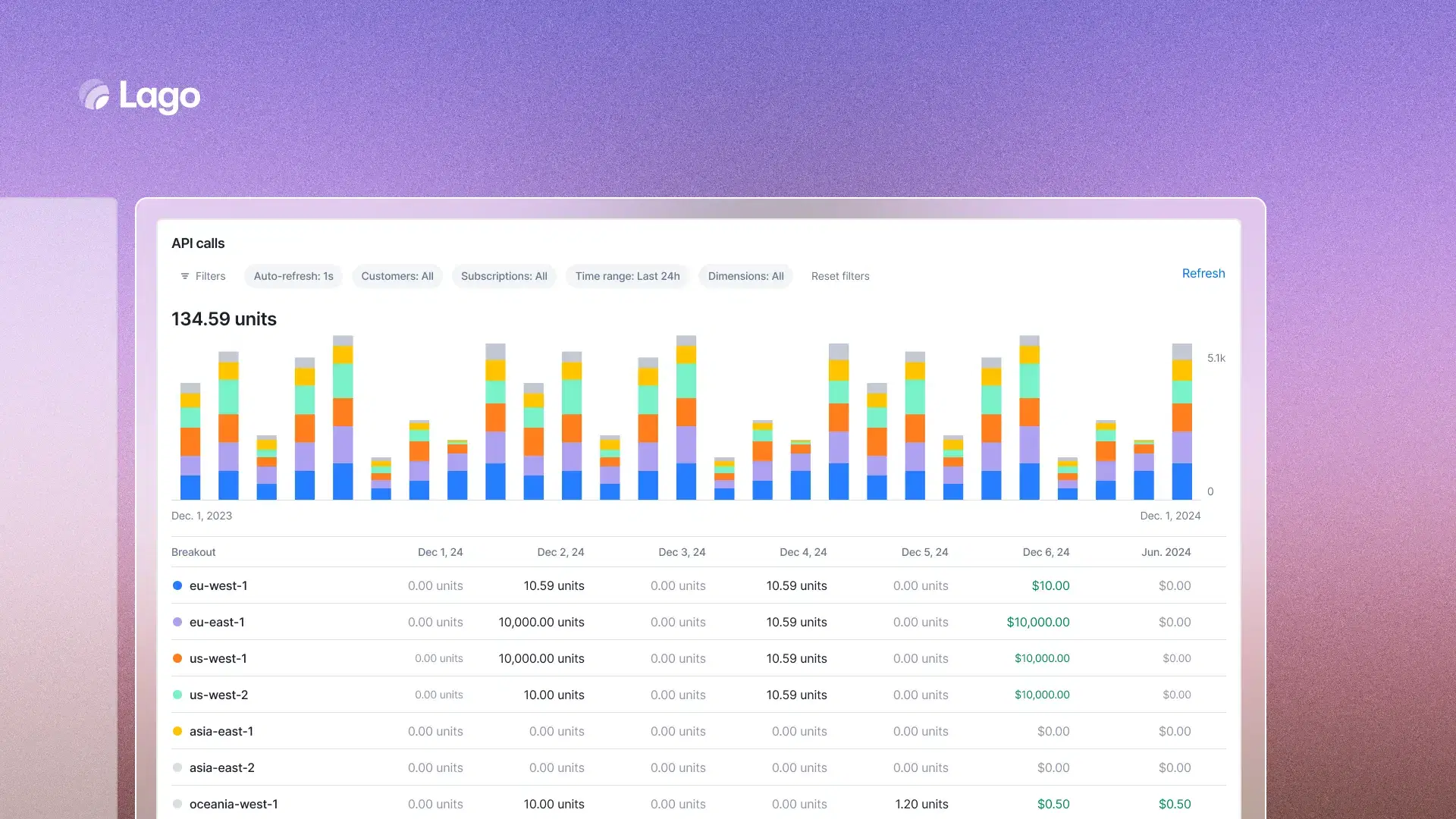
GPU compute is the oil of the AI economy, and billing for it is uniquely complex. This guide explains how AI infrastructure companies design, meter, price, and invoice GPU compute with patterns proven at scale. Examples and pipeline diagrams reference Lago for metering, pricing, progressive billing, and enterprise controls. Lago powers real-world GPU and AI infrastructure deployments that support enterprise SLAs and compliance requirements.
What this guide covers:
Who this is for: engineering, product, and finance teams building GPU clouds, inference platforms, or enterprise AI services.
GPU billing measures continuous, variable-intensity resource consumption across dimensions that matter to customers and operators:
For GPU hardware characteristics and market context, see NVIDIA's data center overview and community GPU comparisons.
Metering should capture the dimensions needed for current price plans and future flexibility. Core metrics:
gpu_hours = num_gpus * seconds / 3600.Example canonical event properties (abbreviated): transaction_id, external_subscription_id, code, timestamp, gpu_type, gpu_count, duration_seconds, avg_utilization, peak_vram_gb, interconnect, region, availability_class, model_name, input_tokens, output_tokens.
Design rule: emit final billing events at job completion (or preempted termination) and include a deterministic transaction_id for idempotency.
For teams billing LLM or inference token usage specifically, rather than raw GPU-hours, Lago's Agent SDK handles the metering and pricing layer directly. It supports two modes: token mode sends raw token counts to Lago for conversion into charges, and price mode calculates dollar costs directly using automatic price lookups from OpenRouter, AWS Bedrock, and Cloudflare. It also accounts for provider-specific quirks, like how cached, reasoning, or audio tokens are counted differently across OpenAI and Anthropic, which is a common source of billing errors when teams build this logic themselves.
For reference, here's a rough sense of where on-demand GPU pricing sits as of mid-2026:
| GPU Type | Typical Range/Hour (on-demand) |
|---|---|
| A100 40GB/80GB | $1.50–$2.50 |
| H100 (SXM/PCIe) | $2.89–$5.19, varies significantly by provider and region |
| H200 | ~$3.99 on-demand, ~$1.99 on spot markets |
| B200 / GB200 (Blackwell) | Rental pricing still stabilizing as availability ramps; not yet a reliable reference point |
Prices are illustrative and change frequently. Map your own pricing to procurement COGS, regions, and interconnect premiums rather than anchoring to public list prices.
Recommended canonical event design:
High-level pipeline:
Example pipeline outcome: progressive invoices when cumulative costs exceed thresholds, so customers aren't surprised by end-of-cycle bills.
Practical engineering notes: aggregate per-second telemetry into job-level billing events at the job boundary, persist raw events for audit and chargeback, and use dynamic pricing fields (precise_total_amount_cents) when runtime pricing is required. For scaling event ingestion and aggregation, consider ClickHouse or similar engines for high-throughput pipelines.
Enterprise customers require additional controls that materially improve business outcomes:
Lago provides enterprise-grade features for these needs, including progressive billing, commitments, and multi-entity invoicing to accelerate time-to-cash and reduce billing errors.
Operationally, this tends to show up as fewer invoice disputes and faster collections with clearer invoice line items, higher stickiness when customers can see per-job cost and set spending caps, and less engineering time spent on ad-hoc billing logic once multi-dimensional pricing lives in one platform.
Essential UX components:
Enterprise buyers expect contract clarity (commitments, discounts, SLAs) and self-service visibility that prevents surprises.
Per-second or per-hour? Per-second for inference (1-minute minimum), per-minute for training. Per-hour rounding risks customer dissatisfaction.
How do you handle hardware price changes? Honor commitments, announce on-demand changes 30 days ahead, and adjust spot pricing in real time.
Should you charge data egress separately? If egress materially affects COGS for the workload, charge separately; otherwise bundle it for simplicity.
How do you price new GPU generations? Use performance and cost ratios plus market positioning to set introductory rates. For Blackwell-generation hardware specifically, expect rental pricing to stay volatile until supply stabilizes, treat early rates as a starting point, not a benchmark.
GPU billing requires a multi-dimensional, auditable, and enterprise-ready billing system that supports both flexible pricing models and strict compliance controls. Adopting a platform designed for usage-based, multi-dimensional pricing reduces engineering overhead, prevents revenue leakage, and improves customer trust.
Lago is an open-source billing platform built for these challenges. It supports enterprise billing solutions with progressive billing, commitments, multi-entity invoicing, and SOC 2 Type II certified controls.
For an enterprise evaluation and implementation plan tailored to GPU compute pricing, book a demo or explore Lago on GitHub.
Teams considering enterprise billing solutions should validate uptime SLAs, auditability, and integration paths with ERP/PSP systems before production rollout.

Anh-Tho Chuong
Anh-Tho Chuong is the co-founder and CEO of Lago, the open-source billing platform. She writes about pricing, business models as code, and using product as a monetization lever.
Share on