


Insights and updates from the billing world.
Lago vs Chargebee: Choose Billing for the Product You Will Sell Next

Oct 15, 2026
How to Choose Billing Software for Enterprise Custom Contracts
Oct 14, 2026
Credit-Based Pricing: Prepaid Credits, Top-Ups and Real-Time Balances
Oct 10, 2026
Usage-Based Billing: The Complete Guide (How It Works, Models, Examples & Software)

Oct 10, 2026
An agent is not an extension of the employee who created it
Sep 21, 2026
The hottest job in the Bay Area might be a billing job at Anthropic
Sep 19, 2026
How Laravel Cloud Gave Developers Control Over Usage-Based Costs
Sep 3, 2026
How to Connect Claude to Your Billing Data with Lago's MCP Server
Aug 26, 2026
AI Agent Pricing: Usage-Based Models for AI Agents and API Calls
Aug 26, 2026
Lago vs Togai: Which Usage-Based Billing Platform Fits Your Stack?
Aug 24, 2026
How to Choose a Billable Metric (and Why Most Companies Get It Wrong)
Aug 24, 2026
AI for RevOps: Where It Helps and Where It Doesn't Yet
Aug 20, 2026
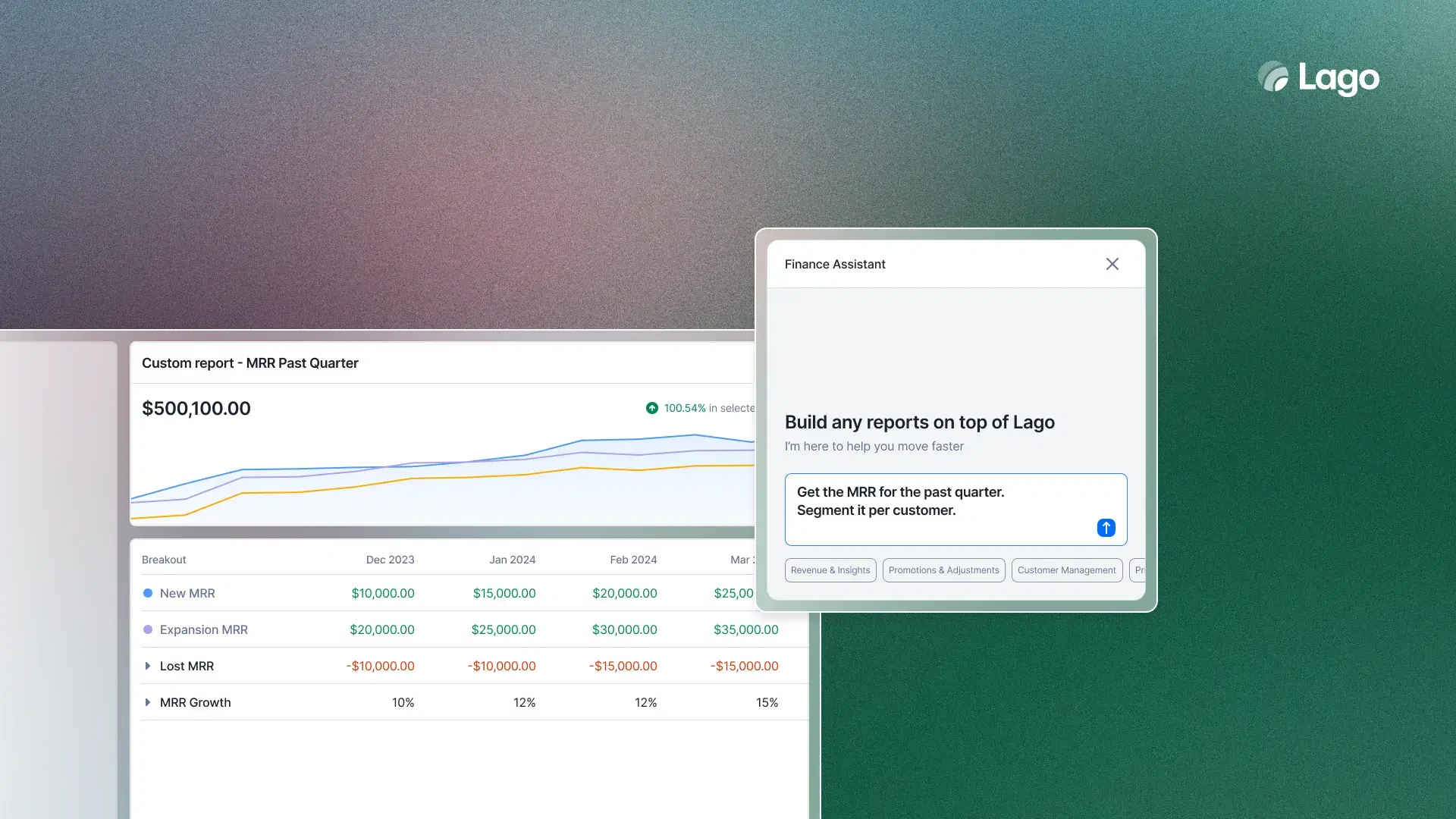
Agentic finance starts with a read-only assistant
Aug 20, 2026
What Is an AI Finance Assistant? (And How Is It Different from an AI Agent?)
Aug 18, 2026
Top Metronome Alternatives for Usage-Based Billing (2026)
Aug 18, 2026
Everyone wants to be the AI gateway
Aug 17, 2026
Generative AI in Finance: Separating the Real Use Cases from the Hype
Aug 14, 2026
AI Agents in Finance: What They Actually Do Today
Aug 12, 2026
Event-Based Billing Explained: Examples & How to Build It
Aug 10, 2026
The AI pricing shift nobody priced correctly
Aug 7, 2026
What Is Metered Billing? How It Works
Aug 4, 2026
By 2027, every AI company will need a billing engineer. Most don't know it yet.
Jul 29, 2026
Why Stripe may pay $10B for a router everyone is building
Jul 27, 2026
AI API Billing: Token-Based Pricing for LLM Products
Jul 24, 2026
Lago vs Orb: Usage-Based Billing for AI and SaaS
Jul 21, 2026
Lago vs Metronome: Open-Source Billing vs an Enterprise Usage-Billing Specialist Now Inside Stripe
Jul 21, 2026
Agent SDK: bill the dollar cost of LLM calls, margin built in
Jul 21, 2026
We killed our motion design job
Jul 21, 2026
Removing humans from the loop has become a status symbol.
Jul 20, 2026
Lago vs Stripe Billing: Feature Comparison, Pricing, and Open-Source Advantages
Jul 20, 2026
Lago vs Zuora: Open-Source Billing vs an Enterprise RevRec Suite
Jul 2, 2026
Pricing and Billing Glossary (2026)
Jul 1, 2026
Self-hosted billing: how to set it up
Jul 1, 2026
Enterprise Pricing: How to Structure a Deal That Can Scale
Jul 1, 2026
Orb Is Being Acquired by Adyen. Here's What That Means If You're Evaluating Usage-Based Billing Platforms.
Jun 29, 2026
Chargebee Alternative? Why Teams Choose Lago for Usage-Based Billing
Jun 26, 2026
B2B SaaS Subscription Management: Best Practices and Strategies
Jun 23, 2026
The AI margin cliff
Jun 19, 2026
Understanding the Pay-as-You-Go Pricing Model for SaaS Businesses
Jun 1, 2026
AI Billing: The Complete Guide
Jun 1, 2026
7 AI Pricing Models: What Works, What Breaks
Jun 1, 2026
AI Billing is (mostly) token plumbing
May 26, 2026
Anthropic took the unfair bullet for ending finger-based pricing
May 26, 2026
Usage-based vs seat-based pricing: 5 models and when each works
May 10, 2026
Dunning, Prepayment, and Spend Caps: How to Stop Unpaid AI Bills
May 1, 2026
From 700 to 6,000+ companies: How Blacksmith scales usage-based billing with Lago
Apr 6, 2026
REST API Design Guide for Billing: Best Practices 2026
Mar 30, 2026
Billing SDK Guide for Developers 2026
Mar 30, 2026
Prepaid Credit API Implementation Guide
Mar 30, 2026
Embedded software is the biggest growth opportunity for open source
Mar 26, 2026
Why Replit's $9B Valuation Looks Cheap
Mar 24, 2026
How to make usage-based revenue auditable: the reconciliation finance needs
Mar 22, 2026
Payment Orchestration: Multi-PSP Routing and Failover
Mar 17, 2026
SaaS Cancellation Flows: Reduce Churn at the Exit Point
Mar 17, 2026
Consumption-Based Pricing for SaaS: What to Know
Mar 17, 2026
Billing Audit Trails: Immutable Logs, Compliance, Forensics
Mar 17, 2026
Real-Time Billing: Stream Processing, Event Sourcing, CQRS
Mar 17, 2026
Billing System Scalability: Horizontal Scaling, Sharding, Multi-Tenancy
Mar 17, 2026
Lago Embedded: White-label, open-source billing
Mar 12, 2026
Vibe-coding platforms monetize. Their users can't.
Mar 11, 2026
Billing Disaster Recovery: Backup, RPO/RTO, and Failover
Mar 9, 2026
Billing Webhook Reliability: Idempotency and Retries
Mar 9, 2026
KYC and AML for Fintech Billing: Implementation Guide
Mar 9, 2026
Audit-Grade Billing Accuracy: Requirements and Testing
Mar 9, 2026
Dimensional Pricing in Cloud Infrastructure: A Technical Framework
Mar 9, 2026
Rating Engine Architecture: From Raw Events to Billable Amounts
Mar 3, 2026
Event Ingestion Architecture: Building Reliable Metering Pipelines
Mar 3, 2026
Subscription Analytics: Cohort Analysis, LTV, and Retention Metrics
Mar 3, 2026
Churn Prediction Models: A Technical Guide for SaaS
Mar 3, 2026
RevOps for SaaS: Building a Revenue Operations Function in 2026
Mar 3, 2026
When building AI chat is actually hard (how and why we built our agents)
Feb 26, 2026
Proration in SaaS Billing: Calculations and Edge Cases
Feb 23, 2026
Revenue Leakage in SaaS: How Billing Gaps Cost 1-5% of ARR
Feb 23, 2026
Billing Tax Automation: Sales Tax, VAT, and Global Compliance
Feb 23, 2026
Self-hosted vs cloud billing: how to decide
Feb 23, 2026
Fintech Billing: Multi-Currency, Real-Time Settlement, and Compliance
Feb 23, 2026
How to Choose a Billing Platform: A Buyer's Framework for 2026
Feb 23, 2026
Dunning Management: How to Recover Failed Payments Without Losing Customers
Feb 23, 2026
How Billing Drives Product-Led Growth: From Free Tier to Enterprise
Feb 23, 2026
5 years of founder grind
Feb 20, 2026
How to Run Pricing Experiments Without Breaking Your Billing System
Feb 20, 2026
How to Bill for GPU Compute: A Technical Guide for AI Infrastructure Companies
Feb 20, 2026
Marketplace Billing: Revenue Splits, Partner Payouts, and Multi-Party Invoicing
Feb 20, 2026
Price Usage by Dimension with Lago Pricing Group Keys
Feb 15, 2026
Why Stripe paid $1B for Metronome instead of fixing Billing
Feb 14, 2026
Why PayPal uses Lago for complex billing at enterprise scale
Feb 13, 2026
Multi-Entity Billing: A Guide for Global SaaS
Feb 13, 2026
Billing System Migration: The Complete Playbook for Replacing Legacy Systems
Feb 13, 2026
Billing Observability: Monitoring, Alerts, and Metrics for Revenue Operations
Feb 13, 2026
Telecom billing: Best practices and systems to use
Feb 1, 2026
What Is the Most Flexible Billing System?
Jan 26, 2026
Most Common Mistakes in AI Pricing (and How to Avoid Them)
Jan 26, 2026
How to set pricing metrics for usage-based and AI SaaS
Jan 26, 2026
AI Agent Monetization: 5 Pricing Models That Work in 2026
Jan 5, 2026
How 1NCE scaled global IoT billing with Lago
Nov 13, 2025
How Flipside Crypto Built Usage-Based Billing for Blockchain Data
Nov 13, 2025
Why Cerebrium "doesn't even think about billing anymore"
Nov 13, 2025
How Porter scaled self-serve billing with Lago
Nov 13, 2025
Lune’s journey to perfecting API pricing (and saving the planet) with Lago
Nov 13, 2025
How Mistral built a billing stack that keeps pace with frontier AI
Nov 13, 2025
Billing Model Migration: Test Revenue Before You Switch
Nov 1, 2025
SaaS Billing System Buyer's Guide: 8 Live Demo Tests
Oct 30, 2025
7 billing models you need to know if you work on pricing
Sep 30, 2025
The best billing solutions for AI products and services
Sep 30, 2025
EU Billing System Checklist: VAT, Invoices, Data, and Usage
Sep 30, 2025
AI Billing Infrastructure: 7 Tests Before You Choose
Sep 30, 2025
What's the best billing system for GovTech companies?
Sep 19, 2025
Air gapped billing system: What it is, how it works and how to build one
Sep 19, 2025
Billing Compliance: GDPR, PCI DSS, and ASC 606 Explained
Sep 19, 2025
Entitlements and billing should be the same system
Sep 9, 2025
How to Evaluate a Billing System: Questions to Ask Before You Commit
Sep 8, 2025
What is revenue forecasting and how does it work?
Sep 8, 2025
How SaaS License Management Works
Sep 1, 2025
What are feature entitlements and how do they work?
Sep 1, 2025
How do entitlements work in SaaS?
Sep 1, 2025
Metered Billing for Cloud Infrastructure: How It Actually Works
Aug 25, 2025
The Complete Guide to Accrued Revenue for SaaS Companies
Aug 25, 2025
Bookings vs. Billings in SaaS: Complete Guide
Aug 25, 2025
How Usage-Based Pricing Increases NRR
Aug 18, 2025
Why we still build with Ruby in 2026
Aug 18, 2025
What Is The Van Westendorp Pricing Model And How Does It Work?
Aug 18, 2025
What is value-based pricing and how does it work?
Aug 11, 2025
What is freemium pricing in SaaS and how does it work?
Aug 6, 2025
Full playbook: How to architect billing systems to power usage-based pricing
Aug 5, 2025
Why building a self-hosted SaaS is a headache (and how we make it easier)
Aug 5, 2025
Usage-Based Pricing: The Implementation Playbook
Aug 5, 2025
Pricing psychology: SaaS pricing strategies that make users buy
Aug 1, 2025
Best AI Billing Software for Small Businesses
Jul 29, 2025
Billing System Software: How It Actually Works
Jul 3, 2025
IFRS 15 for SaaS: Revenue Recognition and Multi-Element Contracts
Jul 3, 2025
Understanding Revenue Recognition Fundamentals
Jul 3, 2025
Usage-Based Revenue Recognition: ASC 606 Explained
Jun 26, 2025
SaaS Billing Best Practices: How to Optimize Your B2B Billing Process
Jun 20, 2025
Launch Week IV Day 3: Lago × Avalara Integration — End Tax Guesswork
Jun 18, 2025
Launch Week IV Day 2: Billing Activity Logs
Jun 17, 2025
Launch Week IV Day 1: Alerts and Budget Limits
Jun 16, 2025
How to monetize APIs: Billing for your API product
Jun 13, 2025
What are hybrid pricing models and how do they work?
Jun 13, 2025
What is outcome-based pricing and how does it work?
Jun 7, 2025
What is consumption-based pricing? And how to implement it
Jun 2, 2025
How to Monetize Developer Tools with Usage-Based Billing
Jun 2, 2025
7 Usage-Based Pricing Tactics: What Snowflake, AWS, and Twilio Actually Do
Jun 2, 2025
10 Usage-Based Pricing Examples With Real 2026 Rates (AWS, Snowflake, Twilio, Stripe)
May 23, 2025
6 AI SaaS Pricing Models That Actually Work
May 19, 2025
Usage-Based Billing: What Actually Drives Revenue Growth
May 13, 2025
Top Billing Platforms Compared: Which One Fits Your Business?
May 8, 2025
Open Source Billing Tools: Customize Your Revenue Engine
May 8, 2025
Usage-Based Billing System: Build It or Buy It?
May 5, 2025
How to add usage-based pricing to an existing SaaS without rebuilding your whole system
May 4, 2025
AI Billing That Works: Smart Solutions for Complex Revenue Models
May 2, 2025
SaaS Usage-Based Billing: Per-Seat, Metered, and Hybrid Models
Apr 30, 2025
The Ultimate Guide to Implementing Usage-Based Billing Models
Apr 30, 2025
Usage-Based Billing for SaaS: How It Actually Works
Apr 23, 2025
Should your SaaS company use usage-based pricing?
Apr 11, 2025
Lago Manifesto: Building billing shouldn't suck (for neither business nor eng)
Mar 31, 2025
Is Y Combinator worth it from Europe? 4 European founders answer
Mar 21, 2025
OpenAI shouldn’t do credits in ChatGPT
Mar 13, 2025
Launch Week III Day 5: Effortless Docker deployment in a single command
Feb 21, 2025
Crypto Payments in Lago: Accept USDC and USDP via Stripe
Feb 20, 2025
I reviewed every snack in our office kitchen
Feb 20, 2025
Launch Week III Day 3: Record manual and partial payments in Lago
Feb 19, 2025
Launch Week III Day 2: Put a ring on it: Partner Billing
Feb 18, 2025
Launch Week III Day 1: Back to the future with invoice previews
Feb 17, 2025
Launch weeks: How to do product marketing for boring products
Feb 17, 2025
Why you shouldn't be your own ICP (we aren't)
Feb 5, 2025
Why DeepSeek had to be open-source
Jan 28, 2025
Billing shouldn’t just be PDF generation
Jan 22, 2025
How we signed a world-famous AI company with a HackerNews post
Nov 20, 2024
Top 7 Alternatives to Zuora for usage-based Billing
Nov 19, 2024
How Lago Uses Lago: Tackling Our Own Billing Nightmares
Nov 13, 2024
Common misconceptions about using Open-Source products
Nov 1, 2024
Top 7 Alternatives to Chargebee for usage-based Billing
Nov 1, 2024
Top 7 Alternatives to Recurly for usage-based Billing
Nov 1, 2024
Top 7 Stripe Billing Alternatives for Usage-Based Billing (2026)
Nov 1, 2024
Prepaid Credits vs Progressive Billing: Trade-offs for Usage-Based Pricing
Oct 31, 2024
Why QA matters: Demystifying the 'QA-Free' philosophy
Oct 18, 2024
Dynamic Pricing: Capture Usage for Variable Rates
Oct 16, 2024
How open can Stripe be?
Oct 16, 2024
Monetize your AI product faster with Lago billing engine
Oct 9, 2024
Fixing Latency Issues in Webflow Using Relume
Sep 25, 2024
Introducing Progressive Billing: Usage-Based Billing Done Right
Sep 4, 2024
Role-based access: billing as a workflow
Jul 26, 2024
Prepaid Credits: Real-Time Burndown, Top-Up Rules, and Wallet Logic
Jul 25, 2024
The ultimate Salesforce package for effortless billing
Jul 24, 2024
Launch Week II Day 2: Track overdue balance and prepare for dunning kick-off
Jul 23, 2024
Launch Week II Day 1: Accounting Integrations
Jul 22, 2024
Pricing AI: A Unit-Based Problem?
Jul 15, 2024
Why Cost can outweigh Performance in DevTools
Jun 26, 2024
Unpacking the B2B Payment Process
Apr 22, 2024
We raised $22 million to build an open-source alternative to traditional payments & billing platforms
Mar 14, 2024
Using ClickHouse to scale your events engine
Feb 24, 2024
The 777‐point Hacker News hit that got us 1000 star
Nov 24, 2023
We’re in Beta, why are they so mad?
Nov 8, 2023
Why companies should consider alpha and beta programs
Oct 29, 2023
Why is calculating Stripe MRR so difficult?
Oct 17, 2023
Open-source does not win by being cheaper
Sep 26, 2023
Why Billing Engineers in Fintechs should be paid more
Sep 20, 2023
Strategies for pricing software products in a down market
Aug 24, 2023
Refunds, Coupons & Credit Notes: why they are different
Aug 16, 2023
Sales Operations, Monetization and Pricing: a chat with Meghan Gill
Aug 4, 2023
1046 upvotes: The ProductHunt playbook that made Lago product of the month
Jul 25, 2023
Timezones: survival tips for engineers
Jul 3, 2023
8 things to consider when choosing your billing system
Jun 28, 2023
ORMs are criticized for the wrong reasons
Jun 21, 2023
'Shape Up' Ryan Singer's advice to YC companies
May 30, 2023
Learnings from 30 years in Go-To-Market: a chat with Jim Stoneham
May 24, 2023
Time Zones in Billing: Why Getting This Wrong Costs Real Money
May 22, 2023
Introducing the feature Fintechs were asking for
Apr 20, 2023
Bill your customers in their timezone, not yours
Jan 24, 2023
Grace period to adjust invoice usage
Jan 24, 2023
Post-mortem of our 1st YC startup: a Reverse ETL
Dec 15, 2022
1000 GitHub Stars in 180 Days: How We Grew Lago's OSS Community
Dec 15, 2022
Engineers interviewing non-engineers: a guide to spotting red flags
Dec 15, 2022
Moving to the US after YC: SF, NYC... or Miami?
Dec 8, 2022
Lessons on monetization, pricing, and PMF: a chat with Elena Verna
Dec 7, 2022
How we got into YC, pre-product, pre-revenue
Nov 11, 2022
How we ship fast: our framework
Nov 8, 2022
5 essential billing features for BaaS companies
Oct 26, 2022
Which pricing model should you choose?
Oct 17, 2022
3 traps for unwary technical founders
Oct 5, 2022
Clone Slack's fair per-seat pricing in a simple way
Sep 30, 2022
How soon should you have a design system?
Sep 28, 2022
The 4 biggest problems with homemade billing systems
Sep 22, 2022
Traveling to the North Pole is like creating a startup
Sep 15, 2022
Pricing, billing & open source: A chat with Algolia's co-founder
Sep 14, 2022
6 steps to build a usage-based billing system
Sep 8, 2022
Does Stripe use Stripe Billing to bill its customers?
Aug 29, 2022
Pivot Series ‒ Part 1: Why we moved away from the no-code reverse ETL space
Aug 19, 2022
Why billing is not just 'Build' or 'Buy'
Aug 17, 2022
Why Heroku-like pricing models are hard to build
Aug 8, 2022
The tech stack we use to build Lago
Aug 4, 2022
Generating PDF invoices using Lago
Jul 28, 2022
Stripe's 21 Products: What They Actually Cost (Full Fee Breakdown)
Jul 21, 2022
Europe needs to catch up on pivot culture
Jul 8, 2022
Cash collection automation
Jun 30, 2022
Sales compensation software
Jun 20, 2022
Comparison of the best CPQ software
Jun 13, 2022
Engineers need open source to end their billing nightmares
Jun 1, 2022
Open-source licensing and why Lago chose AGPLv3
May 30, 2022
Being startup employee number one
May 27, 2022
How to choose a payment gateway for subscription and usage billing
May 23, 2022
The 5 reasons why we chose open source
May 20, 2022
Why B2B billing is hard
May 18, 2022
Why billing systems are a nightmare for engineers
May 16, 2022
Taking part in Y Combinator from Europe: is it worth it?
May 9, 2022
Authorization & Role-based Access Control (RBAC)
May 3, 2022
VCs using scouts means founders get the short end of the stick
Apr 25, 2022
Pricing, my only growth hack at Qonto
Apr 15, 2022
Europe needs to embrace operator angel investors
Apr 11, 2022






































































































Explore the full library of playbooks
The Monetization Academy covers the billing decisions most teams get wrong, and how to get them right. Playbooks for engineering and finance.