AI
An agent is not an extension of the employee who created it

Anh-Tho Chuong•Sep 21•6 min read
Sep 19
/8 min read
Anh-Tho Chuong
Share on


An unofficial technical cheat sheet for the four ownership areas inside one job description.
This is Lago's independent reading of Anthropic's public job description and documentation, informed by our experience building billing infrastructure. Anthropic did not brief us, review this article or endorse its conclusions.
We focus on the systems and commercial decisions specific to this role, not general PM skills or culture fit.
Anthropic's Product Manager, New Markets and Monetization posting is really several founding PM roles. The four briefs are partner and platform billing; enterprise spend controls; one account and wallet across the API and Claude subscriptions; and a vertical.
This guide focuses on the first three connected problems.
In 2022, before ChatGPT or Claude Code, Lago published Why billing systems are a nightmare for engineers. The Hacker News discussion added 359 comments' worth of edge cases. Our original observation was right: billing is product infrastructure, not payment plumbing.
AI kept the old problems and multiplied the consequences. Lago has since implemented monetization infrastructure for AI companies including Mistral AI and Groq, developer platforms including Laravel, and enterprises including Bosch Group ($91B revenue) and Crédit Agricole Group (9th largest bank by assets). The patterns below come from that work.
Our guess, in five parts:
The three problems below are where each of those gets tested.
Give each company one account and wallet across Claude products.
The "user" isn't one thing, and neither is the money behind it:
A company can also buy Claude through seats, included allowances, prepaid API credits, invoiced usage, enterprise commitments and cloud providers. Most API organizations prepay; others settle monthly.
Anthropic tested part of this boundary in May 2026. It proposed keeping interactive Claude and Claude Code inside subscription limits while moving Agent SDK usage, claude -p, GitHub Actions and third-party Agent SDK applications to a separate credit.
We called that "finger-based pricing": the same capability was included while a human was at the keyboard, then metered when software invoked it. Anthropic paused the change before it took effect, so it is not the current model. But it exposed the question: when does one person's subscription stop covering work performed by their agents?
A strong answer separates identity, entitlement, budget, contract and payer, and explains what happens when their rules collide.
| Layer | Question |
|---|---|
| Identity | What human, agent, service account or key made the request? |
| Entitlement | What is that principal allowed to use? |
| Policy | Which rate limit, spend cap or approval rule applies? |
| Funding | Which allowance, wallet, commitment or credit line pays? |
| Contract | Which price and commercial terms apply? |
| Invoice | Who receives and settles the charge? |
One request should pass through all six. Collapsing any two breaks under concurrency, refunds, or a parent/subsidiary contract split.
A user is no longer necessarily a person. An agent performs the work; a human or organization remains accountable for creating it, granting access and funding it.
Give an agent a stable workload identity rather than making it an extension of one employee. Its record can point to an accountable owner, while its entitlement and budget come from the workspace or project sponsoring each run. If one agent serves several teams, each invocation needs an explicit billing scope.
A parent-child account tree is equally easy to oversimplify. A parent can fund the commitment and allocate capacity to subsidiaries. Usage is attributed to the child, then settled against the parent. But that model fails when subsidiaries sign separate contracts, use different currencies or need separate tax treatment. The financial hierarchy may not match the organization chart.
Each can exist at the key, agent, user, team, workspace or parent level. Every proposal needs precedence and inheritance rules.
| Promise | Useful latency | Priority |
|---|---|---|
| Usage dashboard | Minutes | Visibility |
| Budget alert | Seconds or minutes | Time to act |
| Spend cap | Before the next request | Enforcement under concurrency |
| Invoice | Slower is acceptable | Completeness and auditability |
Suppose twenty agents begin work with $100 left. A strict cap requires a reservation before each request starts. Actual usage later consumes that reservation and releases the remainder.
Reservation adds latency and makes authorization an availability dependency. Long-running agents may have no useful maximum cost. Alternatives include bounded overshoot, queuing, model downgrade, rate limits or allowing in-flight work to finish under an overdraft policy.
Lago has worked on both sides of this problem. In our high-volume metering architecture, events flow through Kafka into ClickHouse while invoices and credits remain in Postgres. But fast ingestion alone cannot govern the next request. Lago therefore designed a separate real-time wallet architecture: available credit changes as usage arrives while a durable financial record remains available for corrections and invoicing.
For Claude, a hard cap is checked as an API request is admitted, before it is sent to a model. If that decision depends on a synchronous outside provider, the provider's latency becomes Claude's latency and its downtime can stop requests.
The practical design has two paths:
They will disagree. Reconciliation is part of the design.
Anthropic's own documentation shows the same hierarchy problem: workspaces can have spend and rate limits below an organization-wide limit, while Claude Code can use separate workspaces and per-user keys.
Let customers buy Claude through the cloud provider they already use.
Every handoff between Anthropic and a partner is a place two systems can disagree:
There are two paths:
| Path A: Buy Claude from the cloud provider | Path B: Anthropic calculates; the cloud provider invoices | |
|---|---|---|
| Examples | Amazon Bedrock; Google Vertex AI | Claude Platform on AWS; Claude in Microsoft Foundry |
| What the customer uses | The cloud provider's AI platform. | Claude through an Anthropic-priced marketplace offer. |
| Who calculates the charge | The cloud provider presents its own Claude offering, prices and usage record. | Anthropic measures token usage, applies its model rates and any discount, then converts the result into marketplace billing units. |
| Who sends the invoice | The cloud provider. | AWS or Microsoft, as a line on the customer's existing cloud invoice. |
In plain English: in the first path, the customer buys Claude from AWS or Google. In the second, Anthropic calculates what the customer owes, but AWS or Microsoft puts that amount on the cloud bill and collects it. Both require reconciliation, but the ownership of pricing and usage records is different.
A strong answer traces one API call to cash: every identifier, price transformation, owner, failure state and correction.
Take Claude Platform on AWS. AWS documents that Anthropic rates usage at the applicable model and feature price, applies any negotiated discount, converts the charge into Claude Consumption Units and meters those units hourly through AWS Marketplace. AWS invoices monthly and applies the account's tax settings.
Anthropic documents that spend can take about two hours to reflect recent usage. A customer can exceed a configured limit before requests fail, and that overshoot is billable. The Claude Console shows cost by model and workspace; AWS Cost Explorer shows an aggregated CCU line.
One request can therefore create five separate records:
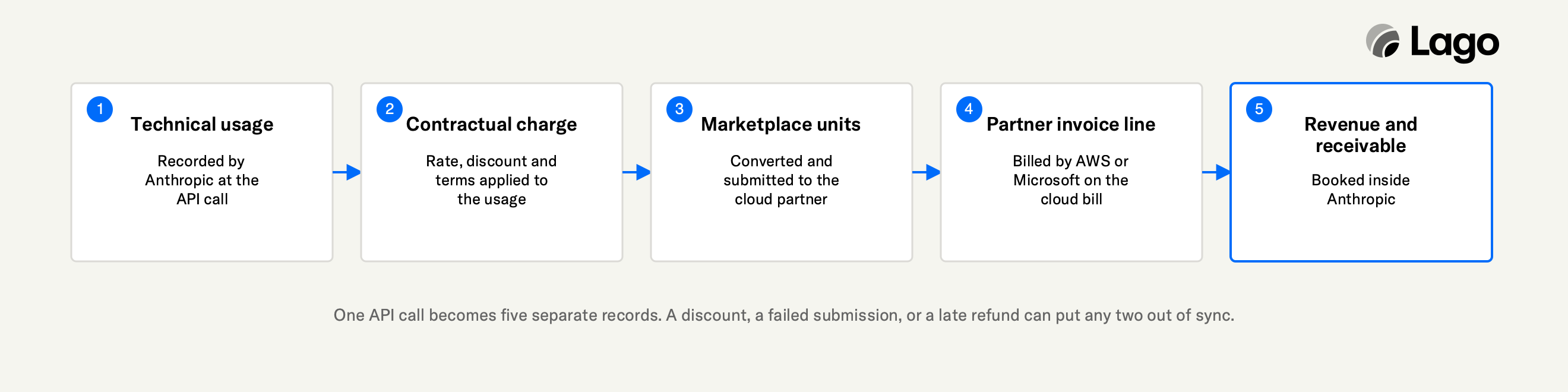
A robust model needs versioned pricing inputs (model, feature, metric, tier, channel, currency, effective date and contractual override) and reconciliation states such as matched, pending, rejected, corrected and written off.
The role likely also includes commercial terms. "The partner receives 20%" is not executable. Twenty percent of list price, net revenue or collected cash? Before or after credits, refunds, tax and marketplace fees? At event time, invoice time or settlement?
The PM likely won't set these terms alone. The work is to form a position with Finance, Legal and Business Development, model the economics, then make the negotiated result repeatable in the product.
The contract is not operational when the PDF is signed. Billing and settlement still need versioned rules.
Give builders accurate token usage and let them handle the rest.
A company building on Claude pays for model usage but may charge for an outcome: a resolved ticket, reviewed contract or completed workflow. One outcome can invoke several agents, models and tools. Retries repeat cost without adding customer value. Model routing can alter margin mid-month.
This is a longer-term differentiation opportunity, not necessarily a current burning problem. Anthropic does not need to invoice those companies' end customers. It could make downstream monetization easier with stable sub-account attribution, granular cost metadata, timely usage streams, correction semantics and controls at project or customer level.
The boundary should stay clear:
Stripe describes six AI pricing models, while ICONIQ reports increasingly hybrid combinations of platform fees, usage, commitments and overages.
A strong answer identifies the smallest useful primitive, the adoption signal that would justify expanding it, and the boundary that prevents Anthropic from building a full billing suite.
An enterprise buys Claude through a cloud partner. A parent funds the commitment, subsidiaries receive budgets, and humans can launch concurrent agents. Mid-month, a discount changes. One marketplace submission fails; a credit is issued after invoice close.
In no more than four pages:
Change one assumption at a time:
A strong candidate likely won't preserve the original architecture at all costs. They'd say which guarantee must change, who absorbs the consequence and what evidence the customer receives.
Before drawing the system, decide who owes whom what, when, under which contract, and which record can prove it.
If you're building this at Anthropic or anywhere else, we've spent years on exactly this infrastructure.
The general version of all this, without the job posting, is here.

Anh-Tho Chuong
Anh-Tho Chuong is the co-founder and CEO of Lago, the open-source billing platform. She writes about pricing, business models as code, and using product as a monetization lever.
Share on