Pricing & Monetization
Credit-Based Pricing: Prepaid Credits, Top-Ups and Real-Time Balances

Anh-Tho Chuong•Oct 10•13 min read
Feb 23
/7 min read
Anh-Tho Chuong
Share on


Revenue leakage in SaaS billing is the systematic loss of earned revenue through gaps in metering, invoicing, pricing enforcement, and payment collection. According to MGI Research, companies lose between 1% and 5% of revenue to billing-related leakage annually — a range that translates to $500,000–$2.5 million in lost revenue for every $50 million in ARR[1]. Unlike churn, which is visible in dashboards, revenue leakage is silent: the revenue was earned but never collected, often without anyone noticing.
The challenge is that revenue leakage rarely comes from a single source. It accumulates across dozens of small gaps — an unmetered API call here, a miscalculated proration there, a failed payment that never gets retried. Each individual leak may be negligible, but their compound effect erodes margins and distorts unit economics. This guide identifies where SaaS companies lose revenue through billing gaps, how to detect leakage, and what infrastructure prevents it.
Revenue leakage in SaaS billing stems from six primary sources: metering gaps where usage goes unrecorded, pricing enforcement failures where discounts or rates are applied incorrectly, proration errors during plan changes, failed payment recovery gaps, credit and refund miscalculations, and contract-to-invoice mismatches where negotiated terms don't match billing configuration. Each source operates independently, and most companies have leakage from multiple sources simultaneously.
The root cause is almost always a disconnect between what the business agreed to charge and what the billing system actually calculates. This disconnect widens as pricing complexity increases — companies using hybrid models (subscription plus usage) have more potential leakage points than companies using flat-rate subscriptions, simply because there are more calculations that can go wrong.
Metering gaps are the largest source of revenue leakage for usage-based SaaS companies. Every event that occurs but isn't recorded is revenue that disappears. Common causes include dropped events during high-throughput periods, events that fail validation and are silently discarded, timezone mismatches between the metering system and the billing system, and aggregation errors that undercount usage.
The scale of the problem depends on event volume and price per event. A company billing $0.001 per API call that drops 0.1% of events at 100 million monthly calls loses $100,000 annually — from a single metering gap. Companies processing high-value events (GPU compute hours, financial transactions) face proportionally larger exposure from even tiny drop rates.
Detection requires comparing metering system counts against billing system counts on a regular cadence. Any systematic discrepancy indicates leakage. Companies focused on billing for product-led growth are particularly vulnerable because PLG models depend on accurate usage tracking to enforce free-tier limits and trigger upgrade prompts — if metering is inaccurate, both revenue collection and growth mechanics break simultaneously.
Pricing enforcement failures occur when the rate applied to a customer doesn't match the rate they should be paying. This happens in several ways: grandfathered pricing that should have expired but wasn't updated, volume discount tiers that don't reset correctly at period boundaries, promotional rates that continue beyond their intended duration, and custom contract terms that aren't correctly translated into billing system configuration.
A 2024 Cledara analysis found that 42% of SaaS companies have at least one active subscription where the billed rate doesn't match the current list price or contracted rate[2]. For companies with hundreds of customers on negotiated pricing, the probability of configuration errors approaches certainty.
The most insidious form of pricing enforcement failure is in graduated and volume pricing tiers. When a customer's usage crosses a tier boundary, the billing system must apply the correct rate to the correct volume segment. A graduated pricing model that charges $0.01 for the first 100,000 units and $0.005 for units above 100,000 requires the system to split usage precisely at the boundary. Rounding errors, off-by-one bugs, and timezone-related boundary misalignment all create consistent underbilling that's nearly invisible in aggregate reporting.
Proration errors create leakage whenever customers change plans mid-cycle and the billing system miscalculates the partial charges or credits. The most common error is using a fixed 30-day denominator for calendar-month billing, which overbills in February (28 days) and underbills in months with 31 days. For a $1,000/month subscription, this rounding error creates a $32.26 discrepancy per plan change in a 31-day month — small individually, but material across hundreds of mid-cycle changes per quarter.
More significant proration leakage occurs when advance-billed subscriptions generate incorrect credit notes during upgrades. If the credit for unused days on the old plan is calculated against the wrong base amount (list price instead of discounted price, pre-tax instead of post-tax), every upgrade creates a systematic over-credit that reduces collected revenue.
Failed payments represent recoverable revenue that becomes leakage if not actively pursued. Industry benchmarks show that 5–9% of subscription payment attempts fail on any given billing cycle, with involuntary churn from unrecovered failed payments accounting for 20–40% of total churn at many SaaS companies[3]. The gap between "payment failed" and "revenue lost" is determined entirely by the quality of the dunning management system.
Failed payment leakage compounds over time. A customer whose payment fails in January and isn't recovered represents not just January's lost revenue, but every subsequent month they would have remained a customer. For a customer with a $500/month subscription and a typical 24-month lifetime, a single unrecovered failed payment represents $12,000 in lifetime value erosion.
Revenue leakage detection requires systematic comparison across four data layers: the contract layer (what was agreed), the configuration layer (what was set up in the billing system), the metering layer (what usage was recorded), and the collection layer (what was actually paid). Discrepancies between any two adjacent layers indicate leakage.
The most effective detection method is automated reconciliation: running scheduled comparisons between CRM contract values and billing system plan configurations, between raw event logs and aggregated usage totals, between invoice amounts and payment receipts, and between expected revenue (contract value times active customers) and actual collected revenue. Any systematic variance beyond a defined threshold triggers investigation.
Manual spot-checking catches obvious errors but misses systemic issues. A company that spot-checks 5% of invoices monthly will catch large one-off errors but miss a graduated pricing tier that consistently undercounts by one tier across 200 customers — a leak that could represent tens of thousands in annual revenue.
Billing observability treats billing data with the same rigor as application performance monitoring. Just as engineering teams set alerts for API latency and error rates, finance and billing teams need alerts for metering anomalies (sudden drops or spikes in event volume), invoice anomalies (invoices significantly above or below historical norms), payment failure rate changes, and credit note frequency increases.
The key metrics to monitor include: metering completeness rate (events recorded divided by events expected), invoice accuracy rate (invoices without post-issuance corrections), collection rate (amount collected divided by amount invoiced), and revenue variance (actual revenue versus contracted revenue). Each metric should have defined thresholds that trigger investigation when breached. Companies that treat billing as infrastructure requiring the same observability as core systems catch leakage before it compounds.
Revenue leakage prevention starts with billing infrastructure that eliminates the gaps where leakage occurs. The three highest-impact prevention measures are real-time metering with delivery guarantees, automated pricing enforcement tied to contract terms, and continuous reconciliation between billing and payment systems.
Real-time metering prevents the most costly form of leakage: unrecorded usage. A metering system that processes events in real time with built-in duplicate detection and delivery guarantees ensures that every billable action is captured. Batch processing introduces windows where events can be lost — the batch job fails, events accumulate beyond buffer capacity, or timestamp boundaries cause events to fall between periods.
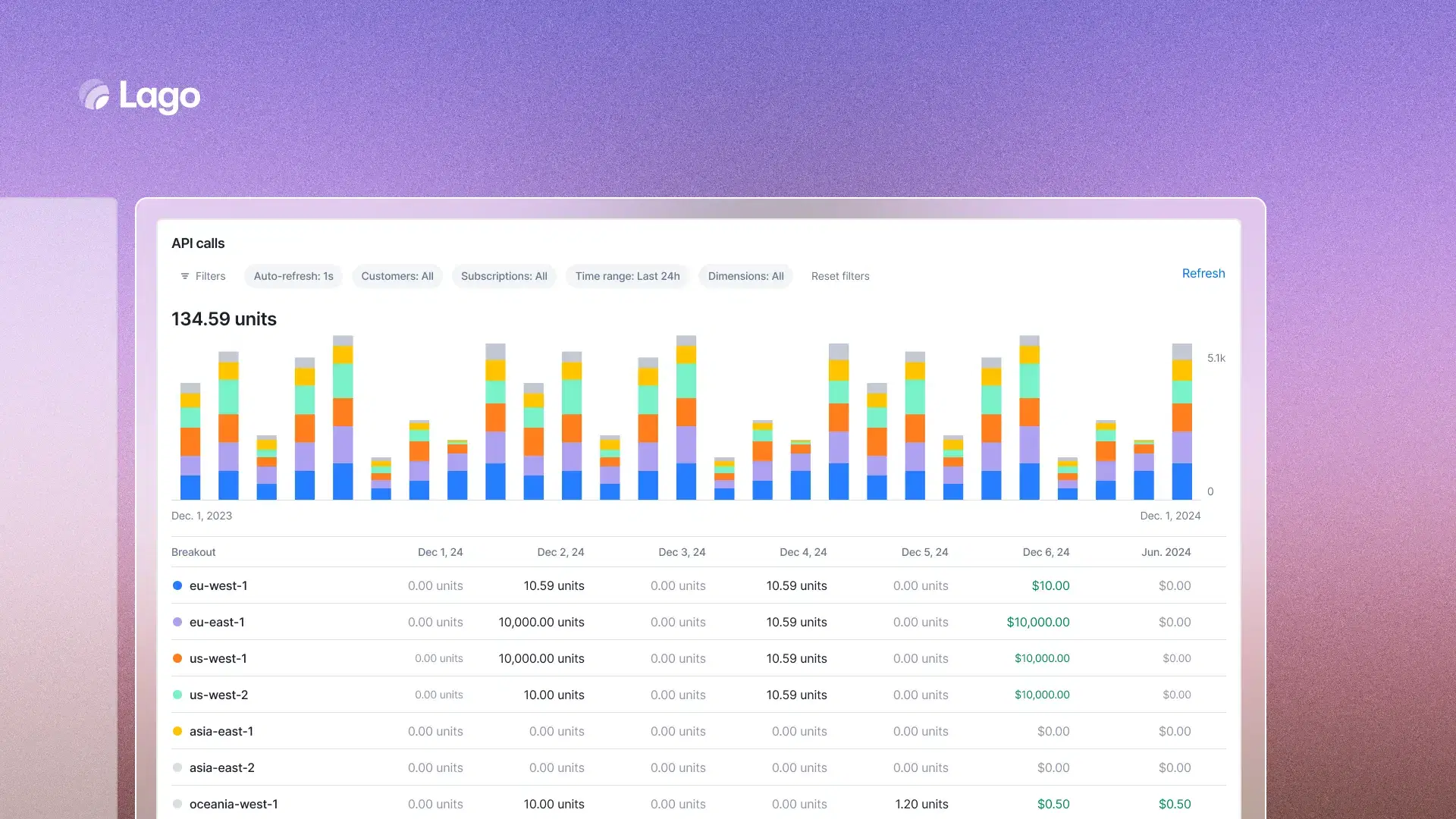
Open-source billing platforms like Lago address metering leakage with real-time event ingestion capable of processing over 1 million events per second, built-in duplicate prevention via transaction IDs, and six aggregation types (count, sum, unique count, max, latest, and weighted sum) that ensure usage is captured accurately regardless of the billing model. The platform's advanced filtering capabilities allow multi-dimensional metering — tracking usage by region, provider, or feature tier simultaneously — which prevents the aggregation errors that cause underbilling in complex pricing structures.
The gap between contract terms and billing configuration is one of the most persistent sources of leakage because it's created by humans and validated by humans. When a sales team closes a deal with custom pricing — a 15% discount, a $5,000 monthly minimum commitment, usage rates that differ from list price — those terms must be exactly replicated in the billing system. Any discrepancy becomes permanent leakage until someone notices.
Prevention requires either automated contract-to-billing synchronization (where CRM deal terms automatically configure billing) or systematic validation workflows where a second person verifies that billing configuration matches contract terms before the first invoice generates. The latter is more common but less reliable as deal volume increases.
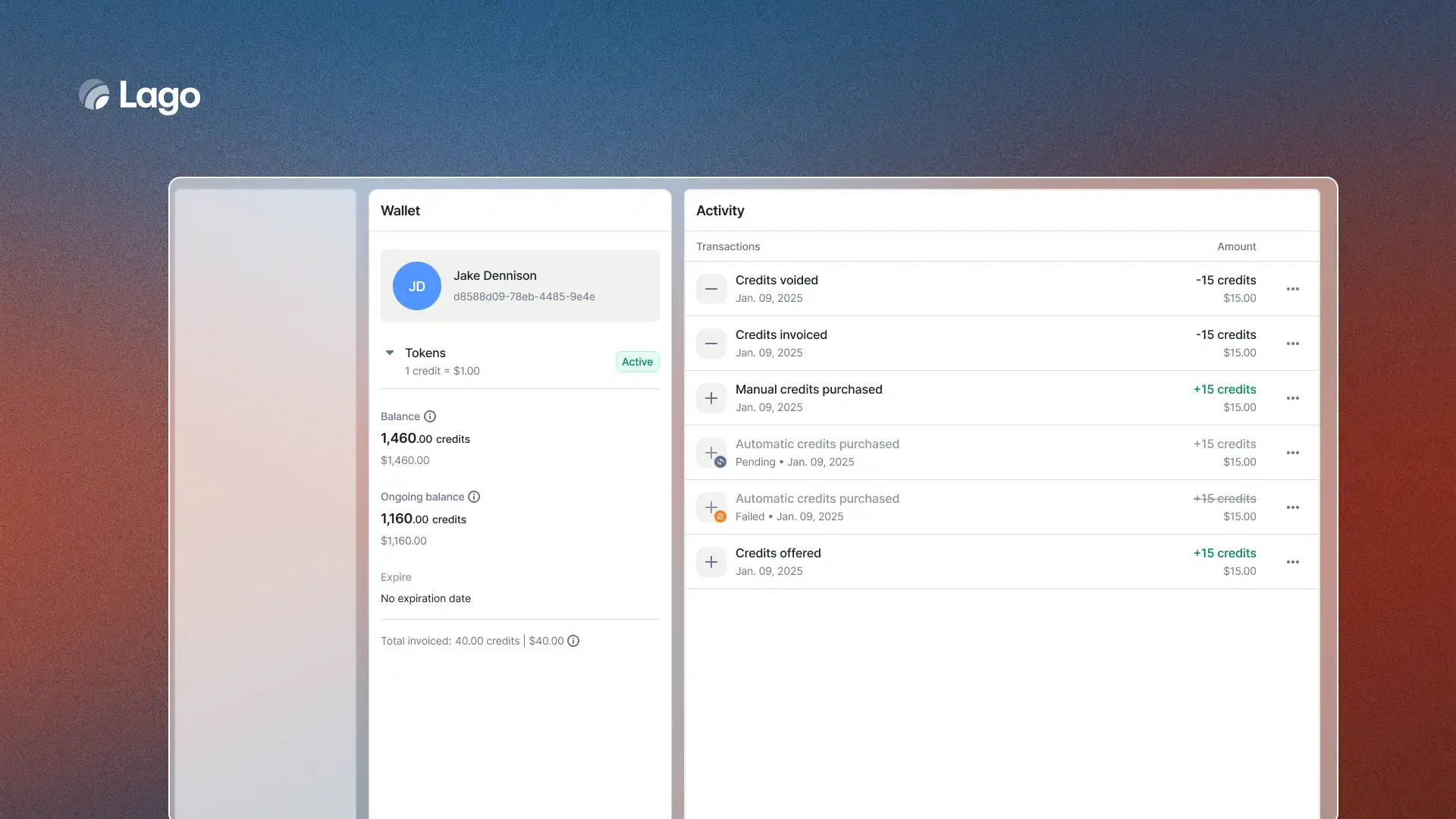
Lago's plan override functionality addresses this by allowing custom per-subscription modifications to subscription amounts, charge properties, commitments, and tax codes — ensuring that negotiated contract terms are reflected in billing configuration without creating one-off plans that diverge from the standard pricing catalog. This reduces the surface area for configuration errors while maintaining the flexibility that enterprise sales require.
Credits and refunds are legitimate financial instruments that become leakage vectors without proper controls. Over-credited accounts, duplicate refunds, credits applied to the wrong invoice, and refunds issued for non-refundable charges all represent revenue that leaves the business incorrectly. According to Chargebee's 2025 State of Subscriptions Report, companies using automated credit management systems reduced credit-related revenue leakage by 34% compared to manual processes[4].
Effective credit controls include: approval workflows for credits above defined thresholds, automatic validation that credit amounts don't exceed the original charge, audit trails linking every credit to a specific reason code, and separation of duties between credit issuance and approval.
Revenue leakage varies by pricing model complexity and billing system maturity. Companies using simple flat-rate subscriptions typically experience 0.5–1% leakage, primarily from failed payment recovery gaps. Companies using usage-based or hybrid pricing models see 2–5% leakage across metering, pricing enforcement, and proration errors combined[1]. Companies with significant enterprise revenue and custom contracts can exceed 5% leakage when contract-to-invoice mismatches are factored in.
The compounding effect makes leakage particularly damaging for growth-stage companies. A company growing at 50% annually with 3% revenue leakage doesn't just lose 3% of current revenue — it loses 3% of an exponentially growing base. Over three years, the cumulative leakage on a $10M ARR company growing to $33.75M represents over $2.5 million in revenue that was earned but never collected.
For companies evaluating their billing infrastructure, revenue leakage should be quantified and included in the total cost of ownership calculation alongside platform fees and engineering costs. A billing platform that costs more per month but reduces leakage by even 1% of revenue typically delivers positive ROI within the first quarter — especially for companies with complex pricing models requiring robust billing infrastructure.
[1] MGI Research, Billing and Revenue Management Report
[2] Cledara, SaaS Management and Spend Analysis, 2024
[3] ProfitWell, Involuntary Churn Benchmarks
[4] Chargebee, 2025 State of Subscriptions Report

Anh-Tho Chuong
Anh-Tho Chuong is the co-founder and CEO of Lago, the open-source billing platform. She writes about pricing, business models as code, and using product as a monetization lever.
Share on