Pricing & Monetization
Lago vs Chargebee: Choose Billing for the Product You Will Sell Next

Anh-Tho Chuong•Oct 15•4 min read
Jul 29
/4 min read
Anh-Tho Chuong
Share on


Most AI companies think they have a billing problem.
The problem is larger. Monetization is now embedded in the product.
Change the model, the agent loop or the definition of a successful outcome. Cost, price and margin can move at the same time. Packaging is no longer a decision finance makes once a year. It is production logic.
By 2027, every AI company will need someone to own that logic.
The role may sit in product, platform, billing or finance. On the product side, Monetization Engineer may be a better name than Billing Engineer.
Billing is part of the job. Not the whole job.
Seat-based SaaS kept product and revenue at a comfortable distance.
Engineering built the product. Finance set a subscription price. Billing counted seats. The eleventh Slack message sent by a user did not create a meaningful new cost for Slack.
AI removed that distance.
A customer asks for one outcome. The agent calls several models, retries failed actions and invokes external tools. One visible task can create hundreds of invisible usage events.
The customer sees a result. The AI company sees an execution graph.
Someone has to turn that graph into a price the customer understands, a cost finance can explain and a margin the company can defend. Tokens rarely solve this. They are an infrastructure unit. Customers want to pay for a resolved ticket, an analyzed document or a completed workflow.
The gap between what the company pays for and what the customer values is the monetization gap.
Which event means the customer received value? Does a retry count twice? Who pays when the model fails after consuming tokens? What happens when a wallet reaches zero halfway through an agent run?
The answers become entitlements, event schemas, credit policies, pricing rules and spend controls. They affect the interface and the architecture.
Monetization decides what the product sells. It also decides what the user can do next if they cannot prove their ability or willingness to pay.
A depleted wallet can block an agent run, limit a feature or route the task to a cheaper model. These decisions happen in near real time. Definitely not at the end of the month.
The product-facing owner covers a loop: product behavior becomes billable usage, then billing state flows back into the product.
They translate value into packaging, entitlements and commercial units. They make usage traceable and pricing versioned. They connect model and infrastructure costs to customers, features and workflows.
This creates the margin feedback loop.
A popular feature can destroy gross margin. A more expensive model may work for one outcome and be irrational for another. Product needs to know while designing the feature, not six weeks after launch.
The role also makes pricing experiments safe to ship. Moving from tokens to credits changes the usage model, customer experience, contract logic and downstream data. It is not a copy change.
This role is adjacent to the Finance Systems Engineer, but not identical.
They share one system. They enter it from opposite sides.
The monetization side is product-facing. Its output is a commercial event the company is ready to charge.
The Finance Systems Engineer is finance-facing. They take that event through invoices, payments, tax, revenue recognition, ERP, reconciliation and close. Their output is revenue the company can report.
One makes monetization executable in the product.
The other makes it correct in the books.
The boundary is the revenue seam where a product event becomes a financial fact.
The invoice sits on the finance side of that seam. In postpaid, rated usage produces the invoice. In prepaid, the invoice and payment fund a wallet before usage. Consumption then draws down the balance and drives revenue recognition.
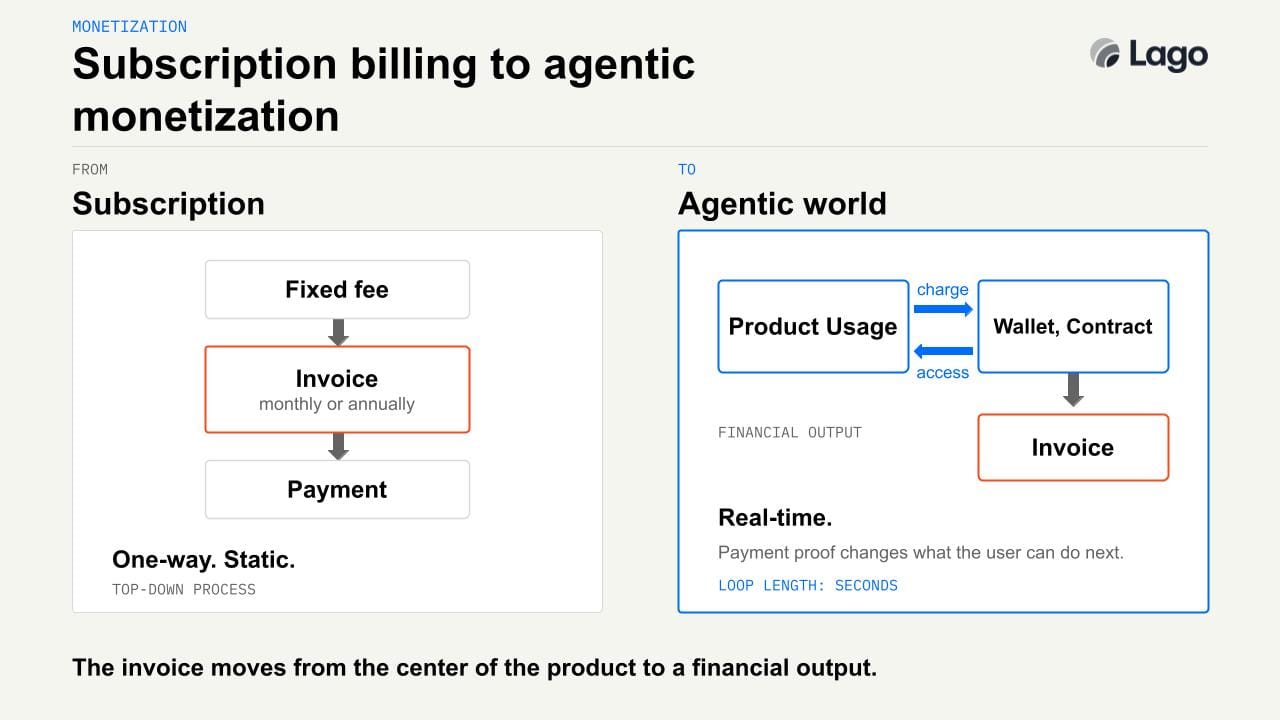
The invoice is not the center of the system. It is one financial output of the loop.
Prepaid credits show the difference. The product-side owner decides what consumes a credit, how models map to units and what the customer sees. The Finance Systems Engineer decides how the purchase, consumption, expiration and refund flow through deferred revenue and the general ledger.
Both need the same truth. They optimize for different outcomes.
The finance role is already visible. Anthropic hires Finance Systems Engineers. OpenAI calls the adjacent discipline Financial Engineering. Replit calls its team Money Infrastructure. Our Rise of the Finance Systems Engineer whitepaper and hiring handbook cover that side.
The product side still has no stable name.
“Billing engineer” captures the implementation. “Pricing engineer” sounds like data science. “Revenue engineer” is already used in go-to-market teams.
Monetization Engineer may be the closest label. It captures more of the surface than billing engineer.
A Series A company does not need two specialized hires.
It still needs an owner.
At first, one senior backend, platform or founding engineer may cover both sides. The title does not matter. The test is whether one person can answer six questions without starting a Slack investigation.
What did the customer consume? Which rule made it billable? Why did we charge this amount? What did delivery cost? How will finance recognize it? Can we reproduce the calculation six months later?
If the answers belong to six teams, monetization has no owner.
The roles separate as the company grows. Product adds packages. Sales adds commitments and exceptions. Finance needs stronger controls. Customers ask for budgets, alerts and explanations.
The org chart follows the revenue architecture.
Product and engineering own value, usage and commercial behavior. Finance owns invoicing, recognition and reporting. The two engineers own the seam together.
Neither role requires the company to build everything internally. It can build the stack, buy a closed product or use an open monetization control plane. The choice is rarely a clean build-or-buy decision.
Tools execute rules. They do not decide what a billable outcome means.
The first person hired to own AI monetization will not spend their day generating invoices.
They will decide what the product sells.

Anh-Tho Chuong
Anh-Tho Chuong is the co-founder and CEO of Lago, the open-source billing platform. She writes about pricing, business models as code, and using product as a monetization lever.
Share on