Pricing & Monetization
Lago vs Chargebee: Choose Billing for the Product You Will Sell Next

Anh-Tho Chuong•Oct 15•4 min read
Aug 18
/7 min read
Anh-Tho Chuong
Share on


Metronome is now part of Stripe. Stripe completed its acquisition of Metronome on January 14, 2026, folding one of the leading enterprise usage-billing platforms into the world's largest payments company. For teams that chose Metronome because it was an independent, best-in-class metering layer that worked alongside any payment stack, that changes the calculus. Billing infrastructure sits underneath every dollar a company collects, and tying it to a single payment processor's roadmap is a different bet than the one many Metronome customers originally made.
This isn't a case against Metronome's engineering. It built genuine depth in rate cards, commits, contract billing, and spend alerting, and plenty of enterprise teams will keep using it well. But if you're evaluating usage-based billing today, either because you're new to the market or because the acquisition changed your risk calculus, it's worth knowing what else is out there and where each option actually differs.
Here are the strongest Metronome alternatives, including where Lago fits and why.
Lago is open-source, developer-first billing infrastructure for usage-based, hybrid, and enterprise pricing. That's us. Biased, but we'll be specific about where the difference actually shows up.
The core distinction from Metronome is deployment and control. Lago ships an open-source core you can self-host, so the billing logic and usage data live on your own infrastructure if that's what your security review, your regulatory environment, or your product roadmap requires. Metronome's public documentation shows a hosted enterprise service with no self-hosted option, which is fine until self-hosting is the requirement, and then it's disqualifying.
The second distinction is payment-processor neutrality. Metronome is increasingly tied to Stripe now that Stripe owns it. Lago connects to Stripe, Adyen, GoCardless, Cashfree, MoneyHash, or a custom PSP, and switching providers doesn't mean re-architecting your billing layer, including routing across multiple PSPs and handling failover between them. If your finance or treasury team ever wants a second payment processor, or if you operate in a region where Stripe isn't the best fit, that flexibility matters more than it looks like on a feature checklist.
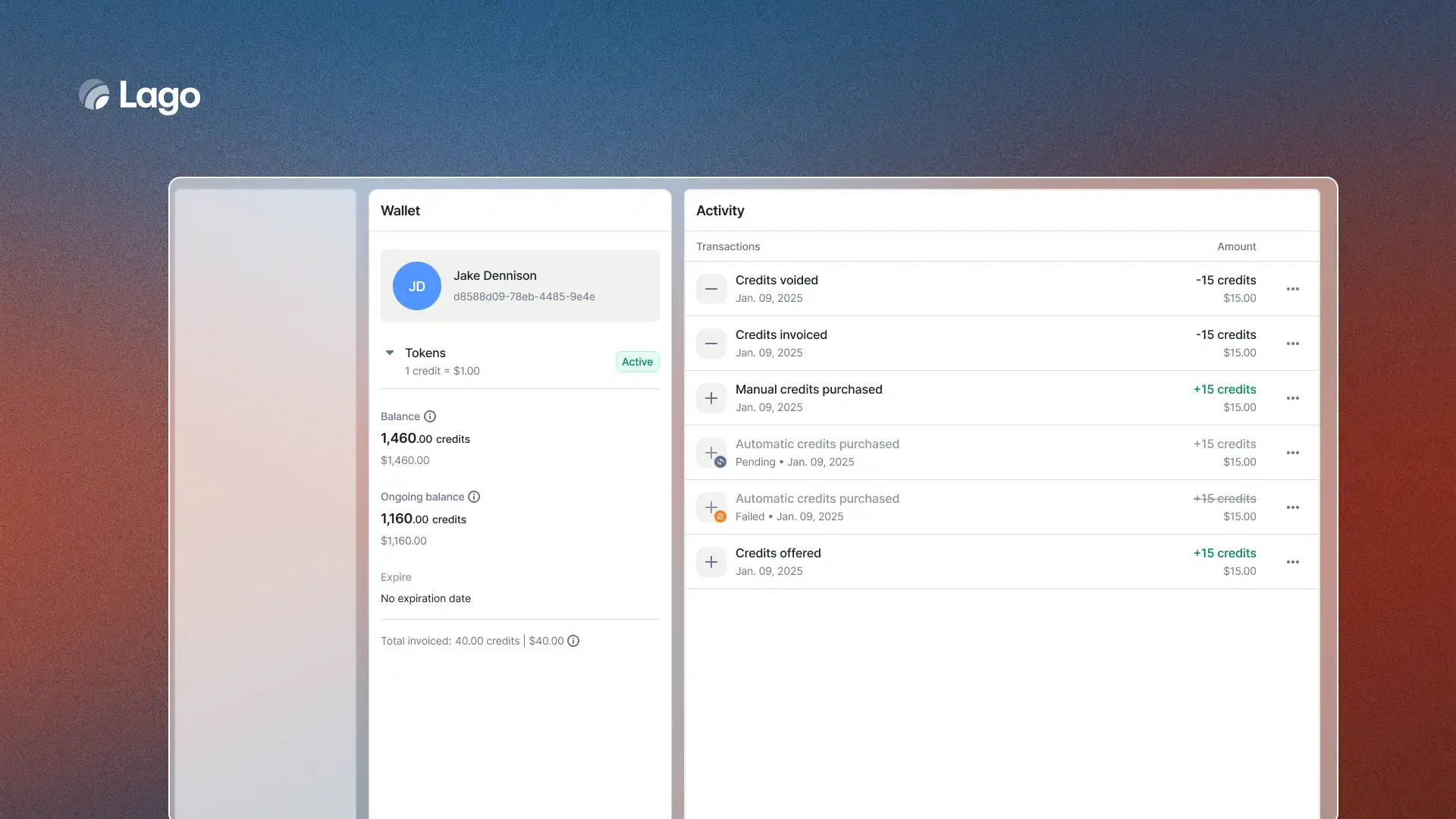
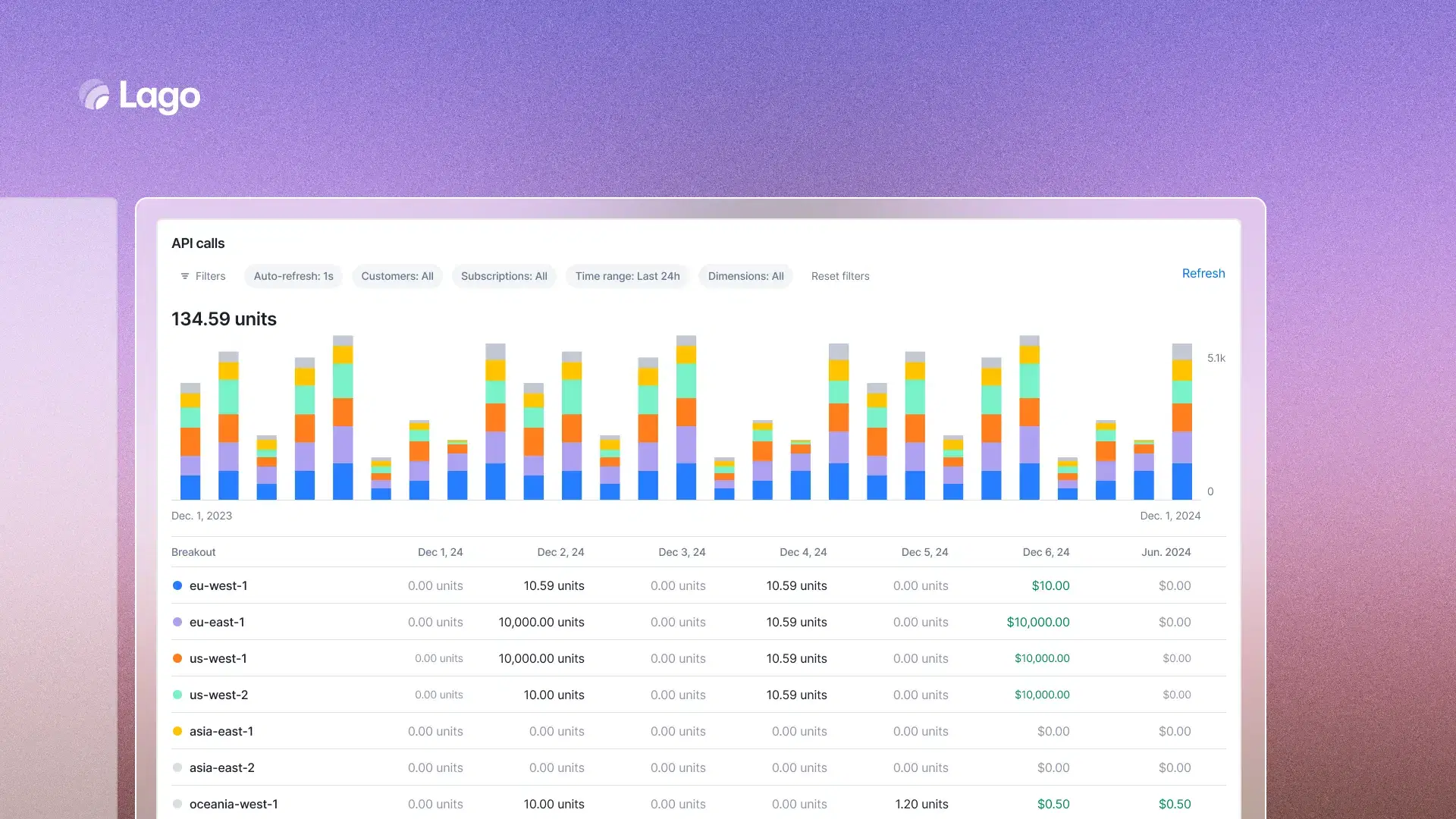
On the metering side, Lago supports high-cardinality usage events with filters and dimensions, and its aggregation types go beyond the basics: count, count unique, latest, max, sum, weighted sum, and custom aggregation for pricing logic that doesn't fit a template. Ingestion runs through REST, batch imports, SDKs, Kafka, Redpanda, Kinesis, or S3, the same foundation we walk through in how to build a usage-based billing system. Wallets and prepaid credits are native, with credit consumption alerts running on a default two-minute interval.
Best for: product, engineering, and finance teams that want to own their usage-based, credit-based, or entitlement-based monetization without being locked into one processor or one vendor's hosted environment. This is a strong fit for AI, API, and infrastructure companies with custom usage metrics, credit packs, and enterprise contracts, and for regulated or self-hosted-only environments.
Where Metronome is still ahead: revenue recognition workflows, contract governance at the very high end of enterprise complexity, and a longer track record with the largest quote-to-cash deployments. Lago doesn't try to be a full payments network either, so if global collection and FX are your primary pain point, pair Lago with a PSP rather than expecting it to replace one.
Pricing: open-source core, with paid cloud and enterprise packaging depending on scale and deployment model.
Orb is a purpose-built usage-based billing platform for pricing iteration, usage ingestion, credits, alerts, and invoicing. It was acquired by Adyen, closing July 1, 2026, alongside Adyen's acquisition of Talon.One. Orb says current customers should see no immediate changes to availability, support, or pricing, and that it remains committed to interoperability.
Orb is strong on pricing-launch speed and has a genuinely useful simulation product for modeling pricing changes before you ship them, something Lago doesn't offer as a packaged UI today. Its alerting is fast, evaluated roughly every three minutes with notifications inside five.
The tradeoff is the same shape as Metronome's, just with a different owner. Orb is a closed, hosted platform, and its public pricing points to custom packages rather than transparent per-transaction rates. Adyen's ownership raises the same long-term neutrality question that Stripe's ownership of Metronome does: a billing layer that's also owned by a payments company has an obvious incentive to route volume toward that company's own processing. We've covered what the Adyen acquisition means for teams evaluating Orb and a full Lago vs Orb comparison in more depth elsewhere.
Best for: product-led infrastructure and AI companies that want deep metering and pricing-simulation tooling and are comfortable with a closed platform and a sales-led pricing conversation.
Pricing: custom, quote-based.
Chargebee is a mature SaaS revenue platform covering subscriptions, entitlements-based usage billing, invoicing, payment workflows, and revenue recognition, with documented support for up to 100 million usage events a month.
It's a solid choice if revenue recognition and finance-team workflows are your primary requirement and you're comfortable with a hosted, closed platform. Chargebee's public documentation shows no open-source or self-hosted option, so if deployment control is a requirement rather than a preference, it sits in the same category as Metronome and Orb on that axis. See our Lago vs Chargebee comparison for a closer look at where the two diverge.
Best for: finance-led teams that want strong RevRec and invoicing workflows out of the box and don't need self-hosting.
Pricing: tiered plans plus custom enterprise pricing; contact sales for usage-based tiers.
OpenMeter is an open-source metering and billing platform. Kong announced its acquisition of OpenMeter on September 3, 2025, and it's being folded into Kong Konnect's metering and billing product. OpenMeter remains open source, and it has some of the strongest real-time entitlement and access-check capabilities in this list, with documented support for limits, quotas, and notifications enforced in real time rather than after the fact.
The open question is the same one that shows up whenever an independent tool gets absorbed into a larger platform: OpenMeter's standalone commercial story is transitioning into Kong's, and its public pricing now routes to Kong or to a sales conversation instead of a transparent, standalone rate.
Best for: teams that specifically need real-time usage-based access enforcement, particularly around API and gateway monetization, and are comfortable adopting it as part of the broader Kong platform.
Pricing: contact sales, post-acquisition.
Flexprice is a developer-first monetization platform aimed at AI-native and SaaS teams, built as an open-core project under an AGPLv3 license. It's the closest thing to a direct open-source, developer-first competitor to Lago, with strong support for credit grants, prepaid and promotional credits, and top-ups.
Flexprice is newer and has a smaller track record at scale than Lago, Metronome, or Orb, so the evaluation question is less about philosophy, since it shares Lago's open-source and developer-first premise, and more about maturity, ecosystem, and how much of your pricing model its current feature set actually covers today.
Best for: early-stage AI and SaaS teams that want an open-core, developer-first billing layer and are comfortable evaluating a younger platform.
Pricing: not publicly listed; contact sales.
Sequence is a revenue platform for flexible pricing, contracts, invoicing, revenue recognition, and CRM and accounting workflows, with a public Growth tier at $799 a month for startups under $1 million in ARR, plus bespoke Core and Scale packaging above that.
Sequence leans toward finance and revenue operations rather than developer-first usage metering, and its published case studies focus on migrations off basic subscription billing rather than complex, high-cardinality usage events. It's worth a look if your billing pain is mostly around contracts, quotes, and revenue recognition rather than metering raw usage at scale.
Best for: revenue and finance teams outgrowing basic subscription tooling who need better contract and RevRec workflows, without heavy usage-metering requirements.
Pricing: Growth tier at $799/month under $1M ARR; custom Core and Scale tiers above that.
Stripe Billing is Stripe's native recurring billing product, priced at 0.7% of billing volume on the pay-as-you-go tier, with annual monthly tiers available above that. It covers basic usage billing through Billing Meters up to Stripe's stated event limits.
Since acquiring Metronome, Stripe now routes most new usage-based billing use cases with real complexity, high-cardinality events, custom aggregation, or enterprise rate cards, toward Metronome rather than trying to solve them inside Billing Meters. That's a useful signal in itself: even Stripe doesn't consider its own native product sufficient for serious usage-based billing anymore, which is part of why it bought Metronome in the first place. For teams weighing this directly, we've written a full Lago vs Stripe Billing comparison.
Best for: teams already fully on Stripe for payments with simple, low-cardinality usage billing needs that don't require custom pricing logic or a second processor.
Pricing: 0.7% of billing volume (pay-as-you-go), or monthly tiers.
If the reason you're reading this is the Stripe acquisition specifically, the question worth asking isn't just "does Metronome still work." It's "who owns the roadmap now, what happens if we ever want a second payment processor, and what does it cost us if percentage-based pricing scales with our volume instead of our usage of the billing product itself." Those are reasonable questions to ask any vendor, but they're sharper ones to ask a billing vendor that a payments company now owns.
Lago exists for teams that want that governance back: open-source, self-hostable, and built to work with whichever payment processor makes sense for a given market or a given deal, without having to renegotiate your billing architecture to do it. Companies like PayPal use Lago for embedded billing, usage metering, multi-currency invoicing, and high-throughput event processing across multiple entities, which is the same kind of complexity Metronome customers are typically solving for, just without the single-vendor dependency.
Metronome is still a reasonable choice if enterprise-grade contract governance and revenue-recognition depth matter more to you than deployment control or PSP neutrality, and if you're comfortable with its new ownership structure. But if control over your own billing infrastructure, and the option to walk away from any single payment processor, is part of what you're evaluating for, Lago is built for exactly that.
If you're comparing more than Metronome, our other alternative guides cover Stripe Billing, Recurly, and Chargebee in the same format.

Anh-Tho Chuong
Anh-Tho Chuong is the co-founder and CEO of Lago, the open-source billing platform. She writes about pricing, business models as code, and using product as a monetization lever.
Share on